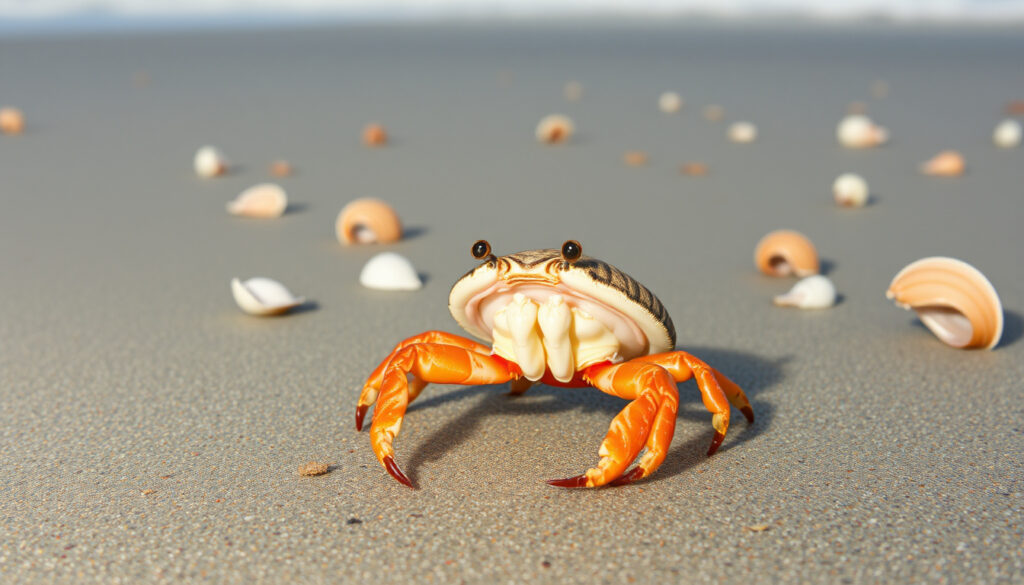
Hermit Crab Without Shell: Survival, Causes & Emergency Care
There’s a particular kind of panic that sets in when you spot a hermit crab wandering around without its shell. That soft, curled abdomen — normally hidden inside a borrowed snail shell — is suddenly exposed, and it’s a clear sign that something is wrong. Whether you’ve found one on the beach or in your own tank, the clock is ticking: a naked hermit crab can die within hours if it doesn’t find a new home. This guide walks through why crabs lose their shells, how long they can survive, and exactly what to do to give them a fighting chance.
Species relying on shells: over 800 · Survival time naked: 24–48 hours · Cause of death: predation and desiccation · First-year pet deaths: estimated 80–90%
Quick snapshot
- Hermit crabs cannot survive permanently without a shell (H-O-M-E.org (hermit crab care resource))
- Without a shell, they are highly vulnerable to predation and dehydration (Wikipedia (encyclopedia))
- Most pet hermit crab deaths occur within the first year due to improper care (Hermit Crab Association (community forum))
- Shell availability is a limiting factor for wild populations (LHCOS (conservation organization))
- The exact maximum survival time of a naked hermit crab in different conditions is not well documented (H-O-M-E.org)
- Whether shell abandonment is ever voluntary healthy behavior outside of molting is debated (Hermit Crab Association)
- The specific neurological mechanisms that trigger shell selection are not fully understood (Happy Hermie (care guide))
- Healthy crabs can survive 24–48 hours without a shell in optimal conditions (H-O-M-E.org)
- Most die within hours in the wild due to predators or drying out (Wikipedia)
- If offered a shell, a naked crab may re-shell within minutes to hours (Happy Hermie)
- Immediately provide a humid, dark environment with multiple shell options (Happy Hermie)
- If the crab does not re-shell within a few hours, isolate it with a small amount of treated water (Happy Hermie)
- Long-term: improve tank conditions to prevent future shell abandonment (LHCOS)
The table below captures the essential facts about hermit crabs and their shells.
| Fact | Detail |
|---|---|
| Scientific name | Superfamily Paguroidea (many species) |
| Lifespan in captivity with proper care | Up to 15–20 years |
| Typical time to find new shell | Minutes to hours, if available |
| Common cause of death (wild) | Predation |
| Common cause of death (captivity) | Improper humidity and temperature |
| Can they regrow a shell? | No, they must find a new one |
Can hermit crabs survive without a shell?
How long can a hermit crab survive without its shell?
- In optimal conditions (high humidity, no predators), a naked crab can survive 24 to 48 hours, according to H-O-M-E.org (hermit crab care resource).
- In the wild, most die much sooner from predation or dehydration (Wikipedia).
- The exact survival time under different environmental conditions is not well documented.
A naked hermit crab is in a race against time: every hour without a shell increases the risk of fatal dehydration or attack. The window for rescue is narrow — measured in hours, not days.
What happens to a hermit crab when it leaves its shell?
- When a crab leaves its shell voluntarily (molting), it does so while inside the shell — it does not completely exit. Complete abandonment is a sign of distress (Hermit Crab Association (community forum)).
- Once out, the crab’s soft abdomen is exposed to air and predators. It loses moisture rapidly and cannot regulate body temperature (Wikipedia).
- Molting is a separate process: crabs shed their exoskeleton while still inside a shell, then re-harden (H-O-M-E.org).
“Hermit crabs, like this one collected in Moorea, usually protect their soft, vulnerable abdomens from predators by reusing empty snail shells.”
— Smithsonian Ocean (marine biology research institution)
The implication: a crab that has left its shell entirely is in crisis, not molting. Immediate intervention is necessary.
What to do if you find a hermit crab without a shell?
Immediate emergency steps
- Keep the crab moist and out of direct sunlight. Use a spray bottle with dechlorinated water (Happy Hermie (care guide)).
- Offer a selection of clean, empty snail shells of appropriate size — slightly larger and slightly smaller than the crab’s current shell (LHCOS (conservation organization)).
- Avoid handling the crab roughly; its abdomen is extremely vulnerable (H-O-M-E.org).
How to provide a safe temporary shelter
- Place the crab in a separate container with a small amount of dechlorinated water (just enough to keep it moist) and the shells. No food or additional items (Happy Hermie).
- Keep the container humid (cover with a lid, leave small air holes) and at a temperature of 75–85°F (Wikipedia).
- Leave the crab undisturbed for one hour, then reassess (Happy Hermie).
Where to find suitable replacement shells
- Natural, unmodified snail shells are best. Avoid painted shells, which may be toxic (H-O-M-E.org).
- Boil shells in saltwater for 10 minutes before offering them to clean and sterilize (Hermie Crab Adventures (care guide)).
- Provide at least three shells per crab to reduce competition (Hermie Crab Adventures).
The most common mistake is offering the wrong shell type or size. A crab that doesn’t find a suitable shell will die. Providing multiple options dramatically increases the chance of re-shelling.
The pattern: rapid, gentle action with the right tools can save a naked crab. Delaying or using the wrong shells nearly always ends in death.
What do you call a hermit crab without a shell?
Common terms: naked crab, bare crab
- There is no single scientific term. Common names include “naked hermit crab” or “shell-less crab” (Wikipedia).
- In marine biology literature, they are described as “individuals without a shell” or “unhoused” (Smithsonian Ocean).
Why there is no official scientific name
- Because shell-less hermit crabs are not a distinct life stage or species — they are simply individuals that have lost their shell (Wikipedia).
- The condition is always temporary and usually fatal, so it hasn’t warranted its own taxonomic label.
The trade-off: using common names like “naked crab” is fine for communication, but it’s important to remember that a shell-less crab is a crab in crisis, not a separate category.
Are hermit crabs born without a shell?
Hermit crab larval stage
- Hermit crabs hatch from eggs as planktonic larvae and do not have shells at that stage (Smithsonian Ocean (marine biology research institution)).
- After metamorphosis into juveniles, they must find and occupy a small empty snail shell almost immediately (Wikipedia).
When and how they first find a shell
- All hermit crabs are born without a shell, but they are not called hermit crabs until they inhabit one (Scottish Seabird Centre (education center)).
- The search for a first shell is a critical survival bottleneck — many juveniles die if they cannot find a suitable shell quickly (Wikipedia).
“All hermit crabs have no shells of their own from birth.”
— Scottish Seabird Centre (Facebook post)
The catch: even in the wild, shell shortage is a real threat. A crab that never finds a shell will not survive its first few days of life.
Why is a hermit crab without a shell in danger?
Predation risks
- The soft, curled abdomen of a hermit crab offers no physical defense against predators (Smithsonian Ocean).
- Shells also provide camouflage and protection from birds, fish, and other crabs (Wikipedia).
Desiccation and heat stress
- Without a shell, the crab loses moisture rapidly and can die from dehydration within hours (H-O-M-E.org).
- Shells also help regulate temperature by providing a microclimate (Wikipedia).
Inability to grow and molt properly
- Shells protect crabs during molting, when they are especially soft and vulnerable (H-O-M-E.org).
- A crab without a shell cannot molt safely and will often die during the process (LHCOS).
The implication: a shell is not just a home — it’s a life-support system. Without it, the crab faces a triple threat of predators, dehydration, and failed molting.
The table below contrasts a hermit crab with a shell versus one without.
| Condition | With shell | Without shell |
|---|---|---|
| Protection from predators | Strong (armored abdomen) | None (soft abdomen exposed) |
| Moisture retention | High (shell retains humidity) | Rapid moisture loss, death in hours |
| Temperature regulation | Stable microclimate | Vulnerable to heat stress |
| Ability to molt | Safe inside shell | Extremely dangerous, often fatal |
| Lifespan in captivity | Up to 15–20 years | Less than 2 days without intervention |
Upsides of intervening with a naked hermit crab
- Can save the crab’s life if shell is offered quickly
- Provides immediate shelter and moisture
- Gives the crab a chance to re-shell and recover
Downsides of intervening with a naked hermit crab
- Handling can stress the crab further
- May not accept offered shell if conditions aren’t right
- Requires proper setup (humidity, temperature, water) to be effective
Emergency steps for a naked hermit crab
- Moisten the crab — use a spray bottle with dechlorinated water to keep it damp.
- Move to a dark, humid container — a small plastic tub with a lid (air holes) works. Place a shallow dish of dechlorinated water inside.
- Offer multiple shells — provide at least 3–5 natural, unmodified snail shells in sizes slightly larger and smaller than the crab’s current shell.
- Leave undisturbed for 1 hour — check after an hour. If the crab has not re-shelled, leave it longer (up to 4 hours).
- If still no shell — try the cup method: place the crab and a shell under a small inverted cup in the container. This may encourage the crab to seek shelter.
- Monitor for 24 hours — if the crab does not re-shell, it may be too weak. Maintain humidity at 80% and temperature at 75–85°F.
Why this matters: without these steps, the crab’s chance of survival is near zero. Each hour without intervention reduces the odds.
Confirmed facts vs what’s unclear
Confirmed facts
- Hermit crabs cannot survive permanently without a shell (H-O-M-E.org)
- Without a shell, they are highly vulnerable to predation and dehydration (Wikipedia)
- Most pet hermit crab deaths occur within the first year due to improper care (Hermit Crab Association)
- Shell availability is a limiting factor for wild populations (LHCOS)
What’s unclear
- The exact maximum survival time of a naked hermit crab in different conditions is not well documented (H-O-M-E.org)
- Whether shell abandonment is ever voluntary healthy behavior outside of molting is debated (Hermit Crab Association)
- The specific neurological mechanisms that trigger shell selection are not fully understood (Happy Hermie)
The pattern: what we know is enough to act — the confirmed facts already give a clear directive. The unknowns are largely academic, not practical.
Quotes from experts and keepers
“Hermit crabs, like this one collected in Moorea, usually protect their soft, vulnerable abdomens from predators by reusing empty snail shells.”
— Smithsonian Ocean (marine biology research institution)
“All hermit crabs have no shells of their own from birth.”
— Scottish Seabird Centre (education center)
“Crabs do not leave their shells while they hunt for new shells. He wouldn’t have left his shell simply because he molted.”
— Reddit community r/hermitcrabs (keeper community)
For a naked hermit crab, the choice is clear: intervene quickly with the right conditions, or watch it die. Every hour matters. For pet owners, the lesson is prevention — stable humidity, temperature, and a constant supply of natural shells are the only way to keep a hermit crab healthy and housed. For those who find a shell-less crab in the wild, a simple rescue kit (a small container, dechlorinated water, and a few empty snail shells) can mean the difference between life and death. The time to act is now.
Related reading: Hermit crab without shell survival emergency care guide · Hermit crab shells housing ethical care and conservation
youtube.com, thekitchenknowhow.com, hermitcrabassociation.com, vetexplainspets.com, reddit.com, youtube.com
Frequently asked questions
Can a hermit crab make its own shell?
No, hermit crabs cannot grow or produce their own shells. They must find and occupy empty snail shells throughout their lives (Wikipedia).
Do hermit crabs feel pain when they are without a shell?
While we cannot know for certain, their soft abdomen contains nerve endings, and being exposed to air and predators likely causes stress and discomfort (H-O-M-E.org).
How can I tell if my hermit crab is molting or distressed?
Molting happens inside the shell — the crab does not completely exit. If a crab leaves its shell entirely, it is distressed, not molting (Hermit Crab Association).
What kind of shells do hermit crabs prefer?
They prefer natural, unmodified snail shells. Avoid painted or lacquered shells, which can be toxic (LHCOS).
Can you put a hermit crab back in its shell?
No, you cannot force a crab back into a shell. The crab must choose to enter the shell itself. Provide suitable shells and let it do so on its own (Happy Hermie).
Is it true that hermit crabs fight over shells?
Yes, when shell supply is limited, crabs may fight over shells and even try to pull another crab out of its shell (Hermie Crab Adventures).
Why does my hermit crab keep changing shells?
Changing shells is normal behavior as they grow. They may also switch if they find a better-fitting or more comfortable shell (Wikipedia).
How often should I provide new shells for my pet hermit crab?
Provide at least three shells per crab at all times, and replace them every few months or when the crab outgrows them (LHCOS).
More related posts
 Fantasy Football Trade Analyzer – Top Tools for Your League
 Brigham and Women’s Hospital: Guide to Boston’s Top Facility
 Breaking Dawn Part 1: Facts, Streaming & Cringey Quotes
 Caves Valley Golf Club: Membership Costs, Ownership & Guide
 What Is a Money Market Account? How It Works and Key Downsides
 Derrick Henry High School Stats: Career Numbers & Records
 What Is Corned Beef? Definition, Nutrition, and Health Impact