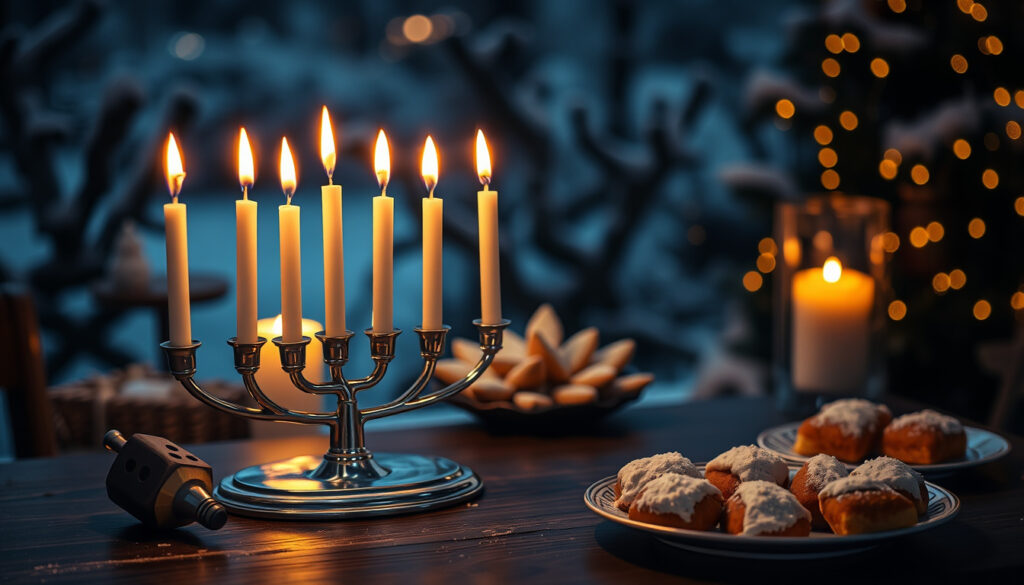
When is Hanukkah 2025? Dates, Traditions & Meaning
If you’re already planning your December calendar, you might be wondering when Hanukkah falls in 2025. The answer is straightforward: Hanukkah 2025 starts at sundown on December 14 and ends at nightfall on December 22.
Hanukkah 2025 start: evening of December 14, 2025 ·
Hanukkah 2025 end: evening of December 22, 2025 ·
Hebrew calendar date: 25 Kislev – 3 Tevet 5786 ·
Number of nights: 8 ·
Duration each night: from nightfall to nightfall
Quick snapshot
- Hanukkah 2025 starts at nightfall on December 14 (Chabad.org)
- Hanukkah 2025 ends at nightfall on December 22 (Chabad.org)
- Hebrew date: 25 Kislev – 3 Tevet 5786 (Hebcal)
- There is exactly one Hanukkah per year (Chabad.org)
- Exact candle-lighting times vary by location (sunset times differ)
- Whether summer time changes affect some communities’ observance
- Plan your menorah lighting schedule for each night (December 14–21)
- Check local sunset times for accurate candle-lighting times
- After Hanukkah, the next Jewish holiday is Tu Bishvat (January 2026)
The implication: the 2025 dates fall squarely in the middle of December, making Hanukkah a convenient time for interfaith families to plan gatherings before the Christmas rush.
| Label | Value |
|---|---|
| First night candle lighting 2025 | December 14, evening |
| Last night candle lighting 2025 | December 21, evening (all 8 candles) |
| Public display | Often in public menorah lightings |
| Gregorian date range | December 14–22, 2025 |
The pattern: four key facts about the 2025 dates — the holiday always starts on the 25th of Kislev, but the Gregorian date shifts from year to year.
When is Hanukkah 2025?
Exact start and end dates for Hanukkah 2025
- Hanukkah 2025 begins at sundown on Sunday, December 14, 2025 (Chabad.org, the leading Jewish outreach organization)
- It ends at nightfall on Monday, December 22, 2025 (Chabad.org)
- The holiday lasts eight nights and days (Chabad.org)
Hebrew calendar equivalent and why dates shift
- Hanukkah begins on the 25th day of Kislev on the Hebrew calendar (Aish.com, a major Jewish educational website)
- The Hebrew calendar is lunar, so Gregorian dates vary from year to year (18Doors, an interfaith family resource)
- Hanukkah can fall anywhere from late November to late December (The Sukkah Project)
The pattern: the Hebrew calendar anchors the holiday, but the Gregorian date floats — and 2025’s mid-December slot is earlier than many people expect.
Are there two Hanukkah in 2025?
Understanding this common misconception requires a look at how Hebrew and Gregorian calendars interact.
Understanding the single annual occurrence of Hanukkah
- There is exactly one Hanukkah each year (Hebcal)
- Hanukkah occurs on the same Hebrew date annually (25 Kislev)
- The Gregorian calendar drift causes some people to think there are two Hanukkah in a year when the holiday appears near the start and end of the Gregorian year
Why some people think there are two Hanukkah in a year
- When Hanukkah falls in early December (Gregorian), some years it may appear twice in the same Gregorian year if it straddles the turn of the year
- That is a calendar illusion — each Hanukkah is a distinct holiday on the Hebrew calendar
The misconception arises because the Gregorian year is longer than the Hebrew year by about 11 days. Over time, the holiday drifts, but it never repeats within the same Hebrew year.
Why this matters: if you see references to two Hanukkah in 2025, they are misunderstanding the calendar — you only need to plan for one.
Why do Jews celebrate Hanukkah instead of Christmas?
This question comes up often in interfaith circles. The answer lies in distinct religious histories and calendars.
Historical reasons for Hanukkah celebration
- Hanukkah commemorates the Maccabean recapture and rededication of the Second Temple in the 2nd century BCE (Wikipedia)
- It celebrates the miracle of a small amount of oil lasting eight days
- Jews do not celebrate Christmas as a religious holiday
Differences between Hanukkah and Christmas
- Hanukkah is a minor Jewish holiday, while Christmas is a major Christian holiday
- Work restrictions are minimal during Hanukkah (see next section)
- The cultural gift-giving aspect of Hanukkah has grown in response to Christmas proximity, but the religious meaning remains distinct
Hanukkah is often called “the Jewish Christmas” in popular culture, but rabbis stress it is not an equivalent. It’s a minor holiday with major cultural visibility due to the December calendar.
The trade-off: Hanukkah’s cultural prominence in December is a product of proximity to Christmas, not religious importance. For interfaith families, it’s important to honor both traditions without conflating them.
What is forbidden on Hanukkah?
Hanukkah is known for its light restrictions compared to other Jewish holidays.
Work restrictions during Hanukkah
- Hanukkah is a minor holiday with few work restrictions (18Doors)
- Melachah (work) is permitted, except for women during the time of candle lighting (Chabad.org)
- Fasting and mourning are prohibited during Hanukkah
Activities that are permitted or prohibited
- You can work, drive, and use electricity on Hanukkah
- Fasting is not allowed (except for medical reasons)
- Public mourning practices (e.g., shiva) are suspended during the holiday
The implication: Hanukkah’s light restrictions make it one of the easiest Jewish holidays to observe while maintaining a normal work and school schedule.
What do Jews do on the first night of Hanukkah?
The first night sets the tone for the week. Here’s what to expect.
Essential rituals and blessings for the first night
- Light the menorah with one candle on the first night (Chabad.org)
- Recite three blessings: two for lighting the candles and one for the occasion (Shehecheyanu)
- Place the menorah in a window or doorway to publicize the miracle
Traditional foods and activities
- Eat foods fried in oil: latkes (potato pancakes) and sufganiyot (jelly donuts)
- Play dreidel (a spinning top game) with family and friends
- Exchange gifts (a modern custom, especially in North America)
The first night of Hanukkah 2025 is December 14, a Sunday. That means families can gather in the evening without weekday work constraints — a rare convenience.
Why this matters: the first night sets the tone for the entire holiday. Knowing the rituals in advance helps families (especially those new to the tradition) feel prepared and connected.
Which year will there be no Hanukkah?
This question stems from a Gregorian-centric view of the calendar.
Why every year has Hanukkah
- Every year on the Hebrew calendar includes Hanukkah (Hebcal)
- No year lacks Hanukkah because the Hebrew calendar is consistent
- Rare cases where the Gregorian calendar appears to skip a date are due to month overlap, not a missing holiday
Calendar mechanics that cause the question
- Because Hanukkah can occur near the end of the Gregorian year (December) or near the beginning (January), some people think it disappears if it falls in January of a given Gregorian year
- For example, if Hanukkah starts on December 26, 2024, it ends in January 2025 — that doesn’t mean 2025 has no Hanukkah; it means the holiday straddles the Gregorian year boundary
The pattern: the question “which year will there be no Hanukkah?” is rooted in a Gregorian-centric view. The Hebrew calendar always includes the holiday.
How to Celebrate Hanukkah 2025
- Confirm your local candle-lighting times using a reliable source like Chabad.org’s 2025 calendar
- Purchase a menorah (hanukkiah) and enough candles for 8 nights (44 candles total)
- Prepare traditional foods: latkes and sufganiyot
- Learn the blessings (available online with audio)
- Set aside time each evening for the lighting ceremony
Hanukkah 2025 Timeline
| Date or period | Event |
|---|---|
| 25 Kislev (Hebrew) | Hanukkah begins at nightfall |
| December 14, 2025 | First night candle lighting |
| December 15–21, 2025 | Intermediate nights; each night add one candle |
| December 22, 2025 | Last night; all eight candles lit; Hanukkah ends at nightfall |
The pattern: the timeline shows a steady buildup — each night adds one candle until the menorah is fully lit on the eighth night.
Clarity Check
Confirmed facts
- Hanukkah 2025 starts December 14 evening and ends December 22 evening (Chabad.org)
- There is exactly one Hanukkah per year (Hebcal)
- Hanukkah is a minor holiday with few work restrictions (18Doors)
What’s unclear
- Exact candle-lighting times vary by location (sunset times)
- Whether summer time changes affect some communities’ observance
“Hanukkah 2025 begins at nightfall on December 14, 2025 and ends at nightfall on December 22, 2025.”
Chabad.org, the leading Jewish outreach organization
“Hanukkah begins on the 25th day of Kislev according to the Hebrew calendar.”
Aish.com, a major Jewish educational website
“The first night of Hanukkah in 2025 falls on Sunday, December 14.”
“Hanukkah is a lunar-calendar holiday and its Gregorian dates vary from year to year.”
18Doors, an interfaith family resource
For anyone planning a December calendar that includes both Hanukkah and other holiday events, the 2025 dates offer a rare alignment: Hanukkah starts on a Sunday evening, which means families can kick off the celebration without the weekday rush. The rest of the holiday falls entirely within the week, ending on a Monday evening. For interfaith families, the clear boundary between Hanukkah and Christmas (which falls on December 25) allows for distinct celebrations. The choice is clear: mark your calendar for December 14–22, and prepare the menorah and latkes — or risk missing the first night.
Those wanting to know the exact menorah lighting times and traditional dishes can refer to Hanukkah 2025 dates and traditions.
Frequently asked questions
What is the miracle of Hanukkah?
The miracle of Hanukkah is that a one-day supply of consecrated oil for the Temple menorah burned for eight days until new oil could be prepared.
How long does Hanukkah last?
Hanukkah lasts for eight nights and days, from the 25th of Kislev to the 2nd of Tevet (or 3rd in some years).
Can I work during Hanukkah?
Yes, work is permitted on Hanukkah, except for women during the time of candle lighting (a custom).
What are traditional Hanukkah foods?
Traditional foods include latkes (potato pancakes) and sufganiyot (jelly donuts), both fried in oil to commemorate the miracle.
Do Jews exchange gifts on Hanukkah?
Yes, gift-giving is a modern custom, especially in North America, influenced by the proximity to Christmas.
Is Hanukkah the Jewish Christmas?
No, Hanukkah is a minor Jewish holiday commemorating a historical event, while Christmas is a major Christian holiday.
What blessing is said when lighting the menorah?
Two blessings are recited: one for lighting the candles (Baruch atah Adonai… asher kid’shanu b’mitzvotav v’tzivanu l’hadlik ner shel Chanukah) and one for the miracle (Baruch atah Adonai… she’asah nisim la’avoteinu bayamim hahem baz’man hazeh). On the first night, a third blessing (Shehecheyanu) is also said.
More related posts
 Indiana Fever vs Minnesota Lynx: Player Stats & Scores
 Social Security Retirement Age Change: Guide to 2026-2033
 AMC Lincoln Square 13: IMAX Size, Showtimes & Cheap Tickets
 How Long to Bake Sweet Potatoes: Times at 350 & 400°F
 Leagues Cup 2026 Matches: Schedule, Teams, and Results
 Self Service Car Wash: Ireland Guide, Prices & Locations
 Pizza Places Near Me – Top Ratings, Delivery and Local Spots
 Talavera vs Real Madrid: Match Result, Mbappé Goals, Club Facts