Chicken Stock vs Broth: Differences, Uses & Health Tips
Stock and broth look nearly identical in the pot, but they behave very differently once they hit your soup or sauce. Stock sets like jelly when refrigerated; broth stays liquid. One delivers 86 calories per cup with collagen-rich body; the other delivers just 15 calories with a lighter, more direct chicken taste. The difference comes down to bones versus meat — and how long you simmer.
Stock made from: bones · Broth made from: meat · Stock contains: gelatin · Broth flavor: delicate · Stock use case: sauces, body
Quick snapshot
- Stock comes from bones; broth comes from meat (Good Housekeeping)
- Stock turns gelatinous when chilled from collagen breakdown (Gourmend Foods)
- Stock has 86 cal/cup vs broth at 15 cal/cup (Good Housekeeping)
- Health benefits like joint recovery and gut healing lack robust human trials
- Nutrition figures vary widely between store-bought and homemade versions
- Definitions overlap in some regions, creating recipe confusion
- A 2015 animal study on glycine and sleep renewed interest in stock as a functional food (Medical News Today)
- Consumer Reports analyzed sodium differences, highlighting stock’s lower salt content (Consumer Reports)
- Bone broth variants are gaining traction in wellness circles for gut-health claims
- Low-FODMAP adaptations for IBS sufferers are becoming more widely available
| Attribute | Chicken Stock | Chicken Broth |
|---|---|---|
| Primary ingredient | Bones | Meat |
| Simmer time | 4–6 hours | ~2 hours |
| Calories per cup | 86 | 15 |
| Protein per cup | 6g | 6g |
| Gelatin content | High | Low |
What’s the Difference Between Chicken Stock and Chicken Broth?
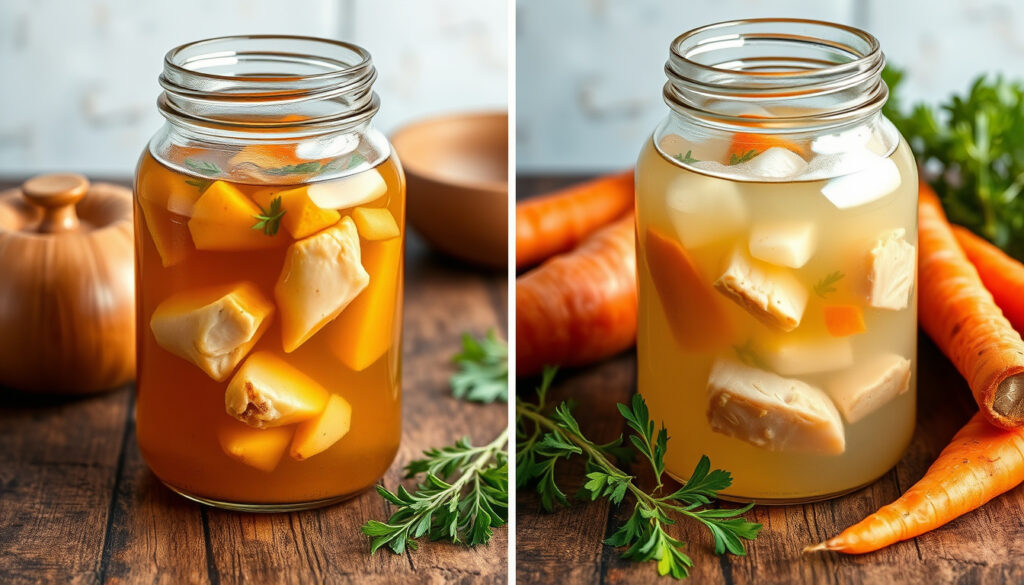
The core distinction comes down to what you simmer and how long you do it. Stock starts with chicken bones — roasted or raw — along with aromatics like onion, carrots, and celery, and cooks for 4–6 hours. That extended simmer coaxes collagen from the bones, which breaks down into gelatin. When you refrigerate stock, it firms up into a wobbly jelly. Broth takes a different approach: it starts with chicken meat, simmers for roughly two hours, and stays liquid even cold. The result is a clearer, more direct chicken flavor without the mouth-coating body that stock delivers.
Ingredients and preparation
Stock uses bones as the foundation. You can add meat scraps, but the bones carry the structural load. Aromatics go in — mirepoix, herbs, sometimes a splash of vinegar to help pull minerals from the bones — then everything simmers low and slow. Broth leans on meat. The chicken itself flavors the liquid, with vegetables and herbs playing supporting roles. Because the meat cooks for a shorter time, broth stays lighter and more delicate.
Flavor and texture differences
“The magic of stock happens during that long, slow simmer. As the collagen in chicken bones breaks down, it transforms into gelatin, giving stock its distinctive body and silky mouthfeel,” according to Good Housekeeping. Stock offers layered, savory depth, though its chicken flavor is less pronounced. Broth punches through with a direct, almost clean taste — the kind you want when you’re sipping it straight from a mug.
Nutritional profiles
The numbers diverge sharply. Stock delivers 86 calories per cup, while broth sits at just 15. Both provide about 6g of protein per cup, but that’s where the similarity ends. Stock’s extended contact with bones extracts minerals like calcium, magnesium, and phosphorus. Broth doesn’t have time to pull those from the bone matrix, so its mineral content stays lower.
Store-bought versions blur the line — some labeled “stock” contain added salt and seasonings that homemade stock wouldn’t. Always check the label if you’re watching sodium intake.
Can You Use Broth Instead of Chicken Stock?
Yes — with conditions. The swap works best when the recipe calls for lightness. In a clear soup, a risotto, or a dish where you want pure chicken flavor without added body, broth performs beautifully. Stock substituting for broth in those contexts, though, adds unwanted viscosity. Your soup turns cloudy and heavy. On the flip side, using broth where the recipe needs stock means sauces won’t coat properly, gravies lack silk, and braised dishes miss that unctuous finish.
Interchangeability in recipes
“Stock can substitute for broth in most recipes, adding richer body,” according to Gourmend Foods. The reverse takes more adjustment. To stretch broth toward a stock-like consistency, you can reduce it by half — concentrating the flavors — or add a tablespoon of gelatin dissolved in warm water.
Impact on soups and sauces
Soups split into two camps. Chicken noodle soup? Stock builds the foundation that broth alone can’t match — the body holds the noodles, coats the vegetables, and makes every spoonful feel substantial. A light vegetable soup or pho? Broth keeps things clean and lets the aromatics lead. For pan sauces and gravies, you need stock’s gelatin to emulsify butter and create that glossy sheen.
When to choose one over the other
Match the ingredient to the dish’s goal. Stock is ideal for braising, deglazing a pan, building risotto, or anywhere a rich mouthfeel matters. Broth works for poaching chicken breasts, light soups, sippy mugs when you’re under the weather, and recipes where the stock’s body would overwhelm delicate flavors. Stock tends to have less sodium than broth, as Consumer Reports notes, because it’s designed as a base for seasoning yourself.
Home cooks who batch-make stock report that the long simmer pays off in versatility — you can dilute it thin for broth-like uses or keep it concentrated. But if you’re sick and want something easy to sip, broth’s quicker preparation wins.
Is Chicken Stock or Broth Healthier?
Health comparisons depend heavily on what your body actually needs. Stock’s collagen breaks down into amino acids — glycine, proline, hydroxyproline — that support joint health, gut lining, and skin elasticity, according to Gourmend Foods. Broth trades that gelatin punch for easier digestion in some contexts. Both contain glycine, which stock and broth contain, and which Medical News Today notes may improve sleep, based on a 2015 animal study.
Nutrient comparison
Stock contains more calories, fat, vitamins, and minerals than broth due to collagen viscosity, according to Good Housekeeping. But that doesn’t automatically make stock “better.” Higher calories matter if you’re watching intake. Broth’s lower calorie count makes it appealing for light meals or calorie-conscious diets.
Health benefits for gut and inflammation
The gut-health angle centers on gelatin. Stock’s gelatin coats the intestinal lining — an effect wellness advocates have championed, though human clinical evidence remains limited. Stock extracts minerals like calcium and magnesium from bones, which some claim supports bone density, though again, direct studies are sparse. For inflammation, broth’s lower purine content may make it gentler on sensitive systems.
Considerations for IBS and gout
For IBS sufferers, low-FODMAP broths eliminate triggering ingredients like onion and garlic. You can adapt stock by substituting scallion tops, leeks, or chives, as Gourmend Foods suggests. For gout, which flares in response to purines, broth generally contains fewer purines than rich meat stocks — making it the safer choice during flare-ups. Neither stock nor broth has been clinically proven to treat either condition, but their mineral and amino acid profiles make them supportive additions to therapeutic diets.
Bone broth, a longer-simmered variant with higher bone-to-liquid ratios, delivers more concentrated nutrients. “Bone broth is like liquid gold: rich in protein, collagen, electrolytes, vitamins and minerals,” according to Rachael’s Good Eats.
Is It Better to Use Broth or Stock?
“Neither stock nor broth is inherently better; it depends on recipe goals,” according to Gourmend Foods. That answer frustrates people looking for a simple answer, but it’s honest. The right choice hinges on what you’re cooking, what your dietary needs are, and what you have access to.
For cooking uses like soup
Chicken noodle soup demands stock. The body turns mediocre broth into something that feels restaurant-quality — the noodles suspend properly, the broth clings to each strand, and the overall mouthfeel feels complete. A light summer soup with fresh herbs and delicate vegetables? Broth keeps it refreshing rather than heavy.
When sick or for taste
When illness strikes, broth has practical advantages. It takes less time to make, it’s easier to sip when your throat hurts, and its lighter flavor sits better on an upset stomach. The glycine in both may support better sleep during recovery, though this benefit remains preliminary. Stock has its own sick-day case: its collagen and minerals support tissue repair, and the gelatin is gentle on the gut.
Conversion methods
Convert broth to stock by reducing it by half and adding dissolved gelatin. Convert stock to broth by diluting with water — roughly one part water to one part stock, adjusting to taste. Neither is a perfect swap, but both get you close enough for most recipes.
Chicken Stock vs Broth for Health Conditions
Specific health conditions tilt the scales toward one option. IBS, gout, and inflammatory issues all have distinct nutritional needs that stock and broth meet differently.
IBS-friendly options
Traditional stock and broth use onion and garlic — both high-FODMAP ingredients that trigger IBS symptoms in many people. Low-FODMAP adaptations substitute with the green parts of scallions, leeks, or chives. Broth made without high-FODMAP aromatics gives IBS sufferers a safe base for soups and sauces.
Gout safety
Gout flares when purines break down into uric acid. Meat-based stocks contain more purines than broth. Chicken broth made primarily from meat, rather than concentrated bone extractions, keeps purine levels lower. If you’re managing gout, broth from meat rather than bone-heavy stock is the safer daily choice.
Anti-inflammatory potential
Collagen-derived amino acids in stock — particularly glycine — have anti-inflammatory properties in laboratory studies. Whether those translate meaningfully to human inflammation reduction is still unclear. Broth’s lower gelatin content may mean fewer anti-inflammatory benefits, but it also means fewer compounds that might interact with sensitive systems.
Stock vs Broth: Head-to-Head Comparison
Five dimensions, one clear picture of how these two kitchen staples stack up.
| Dimension | Chicken Stock | Chicken Broth |
|---|---|---|
| Base ingredient | Bones with aromatics | Meat with aromatics |
| Simmer time | 4–6 hours | ~2 hours |
| Calories per cup | 86 | 15 |
| Gelatin content | High — sets when cold | Low — stays liquid |
| Best uses | Sauces, gravies, braising, noodle soup | Clear soups, poaching, sipping, risotto |
| Sodium level | Typically lower (unsalted bases) | Often higher (seasoned versions) |
| Collagen amino acids | Glycine, proline, hydroxyproline | Minimal |
| Gout-friendliness | Higher purines from bone extraction | Lower purines from meat focus |
| IBS compatibility | Requires FODMAP-substituted version | Same — needs adaptation |
The pattern is clear: stock builds richness and body; broth stays light and flexible. Neither is universally superior — the choice follows the cooking goal.
Upsides
- Stock’s gelatin gives sauces and gravies a silky, emulsified finish
- Collagen breakdown extracts minerals and amino acids from bones
- Stock’s lower sodium makes it easier to control seasoning
- Bone broth variants offer the most concentrated nutrient profile
Downsides
- Stock’s 86 calories per cup exceeds broth’s 15 — relevant for calorie tracking
- Long simmer time (4–6 hours) limits spontaneity
- Bone-based purines can trigger gout in sensitive individuals
- Stock’s body overwhelms delicate dishes like clear vegetable soups
How to Make Each at Home
Homemade versions outperform anything on shelves — here’s how to make both.
Making chicken stock
- Place chicken bones in a stockpot or Dutch oven
- Cover with water by about 2 inches
- Add roughly chopped onion, carrots, and celery — roughly 1:1:1 ratio
- Drop in herbs: bay leaf, thyme, parsley stems
- Bring to a simmer over medium heat, then reduce to very low
- Cook for 4–6 hours, skimming foam occasionally
- Strain through a fine-mesh strainer, discarding solids
- Cool and refrigerate — gel forms within hours if properly concentrated
Making chicken broth
- Place chicken pieces — thighs, wings, or a whole bird — in a pot
- Cover with water by 2–3 inches
- Add vegetables: onion, carrots, celery, and herbs
- Bring to a boil, then reduce to a gentle simmer
- Cook for about 2 hours until chicken is fully cooked through
- Remove chicken, shred the meat for other uses, return bones to pot if desired
- Strain and season lightly — broth needs less salt since it’s often sipped on its own
“Homemade chicken bone broth contains about 90 calories, 6g protein, 3g fat, 9g carbs per cup,” according to Community Food Co-op. Store-bought stock tends to be pricier due to the labor-intensive production process, as Good Housekeeping notes.
Clarity section
- Stock from bones, broth from meat
- Gelatin in stock causes jelling when cold
- Stock simmers 4–6 hours; broth simmers ~2 hours
- Extent of health benefits from collagen — human trials lacking
- Precise nutrient variation between homemade and store-bought
“The magic of stock happens during that long, slow simmer. As the collagen in chicken bones breaks down, it transforms into gelatin, giving stock its distinctive body and silky mouthfeel.”
— Good Housekeeping (Food and Recipe Lab)
“What bone broth provides in nutritional quality far outweighs any regular packaged chicken or beef broth found in stores today.”
— Community Food Co-op (Nutritionist Resource)
The Takeaway
Stock and broth are different tools for different jobs. Stock builds the body and silkiness that elevate sauces and hearty soups, pulling collagen and minerals from bones during a long simmer. Broth stays light and flexible, delivering clean chicken flavor for lighter dishes, poaching, or sipping when you’re under the weather. Neither is a villain — and both belong in a well-stocked kitchen. For home cooks, the practical move is to make and keep both, then match each to the dish rather than treating them as interchangeable.
Related reading: Just Bare Chicken Nuggets nutrition
While broth cooks quicker with meat, chicken stock demands longer simmering of bones, as detailed in this homemade chicken stock recipe that yields gelatinous depth for recipes.
Frequently asked questions
What broth is good for IBS?
IBS-friendly broth eliminates high-FODMAP ingredients like onion and garlic. Substitute with scallion tops, leeks, or chives. Low-FODMAP broth gives you the base without the triggers.
Is chicken broth gout friendly?
Chicken broth tends to be lower in purines than meat-heavy stocks, making it the safer choice during gout flare-ups. Broth made primarily from meat rather than concentrated bone extraction keeps purine levels manageable.
Can you drink chicken stock like broth?
Yes — but you may want to dilute it. Stock’s concentrated body and gelatin content can feel heavy when sipped straight. Dilute with an equal part water, or use a less-concentrated homemade version.
How do you convert chicken stock to broth?
Dilute stock with an equal part water to approximate broth’s lighter body. Alternatively, reduce broth by half to concentrate its flavor toward stock-like richness.
Chicken stock vs bone broth?
Bone broth is a longer-simmered variant of stock, cooked with a higher bone-to-liquid ratio for more concentrated nutrients. Stock simmers 4–6 hours; bone broth often goes 12–24 hours. Both are bone-based, but bone broth is more nutrient-dense.
Chicken stock vs broth when sick?
Broth wins for sick-day practicality: shorter prep time, lighter flavor, easier to sip on a sore throat. Stock’s minerals and gelatin support tissue repair and gut health, but its intensity may feel overwhelming when you’re under the weather.
Chicken stock vs broth for chicken noodle soup?
Stock is the clear winner. Its body coats the noodles, gives the broth substance, and creates that hearty, restaurant-quality feel. Broth works for a lighter soup, but stock transforms mediocre chicken noodle soup into something memorable.
Chicken stock vs broth taste?
Stock delivers layered, savory depth with less pronounced chicken flavor — the bones and collagen create complexity. Broth punches through with direct, clean chicken taste. Stock feels unctuous and coating; broth feels bright and refreshing.
More related posts
 Symptoms of Mold Exposure: How to Know, Test, and Recover
 High BUN/Creatinine Ratio: Causes, Symptoms & How to Lower It
 La Boo-Boo – The Truth About Labubu’s Name Origin
 June 2025 Social Security Schedule: Payment Dates and COLA Update
 Who Won Super Bowl 2023? Chiefs Beat Philadelphia Eagles 38-35
 Donut Shops Near Me: Best Donuts in Dublin (Open Now & Menus)
 Home Remedies for Cold: Evidence-Based Tips for Fast Relief
 What Is a Caper? Definition, Taste, and Health Benefits