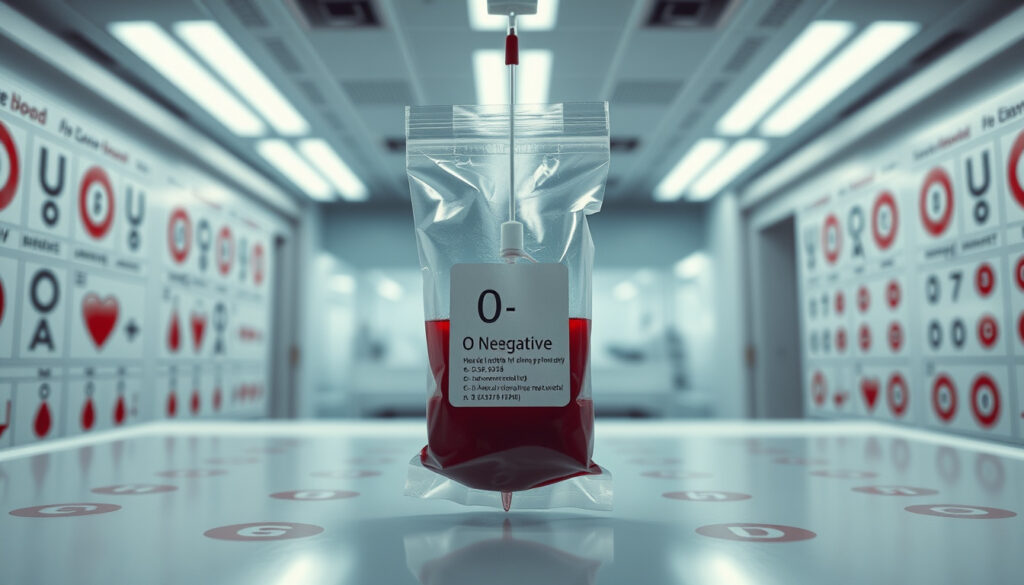
Universal Donor Blood Type: O Negative Myths & Facts
“I’m O positive, I can give to anyone.” That statement is actually one of the most persistent myths in blood donation—and it could lead to dangerous transfusions. O negative truly stands alone as the universal donor, but the reasons why matter more than most people realize.
Universal Donor: O negative · Can Donate To: All blood types · Universal Recipient: AB positive · O Negative Rarity: About 7% of population · Rarest Type: AB negative
Quick snapshot
- O negative is universal donor for red blood cells (American Red Cross)
- 7% of US population has O negative blood (American Red Cross)
- One car accident victim may need up to 100 units of O negative (American Red Cross)
- ADHD-blood-type links lack scientific consensus (We Are Blood)
- Limited verified global prevalence data beyond US and UK (NHS Blood Donation)
- Power Red donation height requirement changed to 5’3″ for females (American Red Cross)
- Ongoing Red Cross calls for O- donors due to shortages (American Red Cross)
- Enzymatic conversion research aims to create universal O from other types (NIH/PMC)
- Demand for O negative continues to outpace supply (NHS Blood Donation)
These figures show why O negative is both scarce and critical.
| Label | Value |
|---|---|
| Universal Donor Type | O negative |
| Why Universal | No A/B antigens, Rh negative |
| Rarity Ranking | AB- rarest at 1% |
| O Negative US Prevalence | 7% of population |
| O Positive US Prevalence | 38% of population |
| UK O Negative Prevalence | 8% of population |
| O Negative Hospital Requests UK | 13% of red cells |
Is O+ also a universal donor?
No. O positive is not a universal donor, and this confusion can have serious consequences in transfusions. O negative is the only blood type that can be safely given to any recipient without triggering an immune response. O positive carries the Rh antigen, which makes it incompatible with the roughly 15% of the population that is Rh negative.
Differences between O+ and O-
O negative blood lacks A, B, and Rh (RhD) antigens entirely. When transfused, the recipient’s immune system sees nothing to attack. O positive, meanwhile, contains the Rh antigen along with no A or B antigens, making it safe only for recipients who are Rh positive.
The distinction matters most in emergencies when there is no time to determine a patient’s blood type. According to the American Red Cross, “O negative is the universal blood type and what emergency room personnel reach for when there is no time to determine a patient’s blood type in the most serious situations.”
O positive is compatible with all Rh-positive blood types (A+, B+, O+, AB+) but cannot be given to Rh-negative patients (A-, B-, O-, AB-). This limitation is why O positive is not universal despite being the most commonly transfused type.
Only O negative deserves the “universal donor” label. O positive works for 85% of the population but fails the remaining 15%—making it unsuitable as a universal option in critical care settings.
Why is O positive better than O negative?
This framing deserves scrutiny. O positive is not “better” in the sense of being safer or more versatile—it is simply more available. In practical terms, O positive has one key advantage: volume. With 38% of the US population carrying O positive blood compared to just 7% for O negative, supply is less constrained.
Donation versatility
Type O negative blood donors are especially needed for emergencies, as the American Red Cross states, it “is the first choice when patient type is unknown.” Air ambulances carry O negative specifically because universal compatibility matters when every second counts.
However, O positive donors are not without value. The American Red Cross notes that “Type O positive blood is given to patients more than any other blood type, which is why it’s considered the most needed blood type.” Over 80% of the population has a positive blood type and can receive O positive safely.
Recipient limitations
While O positive works for most recipients, it cannot help Rh-negative patients. In the UK, NHS Blood Donation reports that O negative represents 8% of the population but accounts for 13% of hospital red cell requests—a stark reminder that rarity creates demand that outpaces supply.
The trade-off is clear: O negative donors serve everyone but are scarce. O positive donors serve the majority but cannot help the minority who are Rh negative.
O negative runs out first during shortages because demand from emergencies is constant. Blood banks constantly call for O negative donors, yet the supply remains limited to just 7% of the population.
Why is AB+ a universal recipient?
AB positive holds the opposite status of O negative. While O negative gives to everyone, AB positive receives from everyone. The reason lies in what antigens are present on red blood cells—and what antibodies float in the plasma.
Antigen absence
AB positive red blood cells carry both A and B antigens, plus the Rh antigen. This means their immune system already tolerates these markers. When receiving blood, the recipient’s antibodies would attack foreign antigens. AB positive patients have neither anti-A nor anti-B antibodies, making them uniquely flexible recipients.
The Rh factor adds another layer. AB positive patients can receive from any Rh-positive or Rh-negative donor, provided the ABO match is compatible. However, plasma compatibility runs in reverse: AB plasma can go to anyone, making AB donors valuable for plasma products.
Compatibility rules
The chart looks like this: O negative donors serve all eight blood types; O positive donors serve four types (A+, B+, O+, AB+); AB positive recipients accept from all eight types but donate only to AB+.
This symmetry reveals why blood type distribution matters for healthcare planning. The rarest blood type (AB negative at roughly 1% of the population) faces unique challenges in finding compatible plasma and platelet donations even while being the universal plasma recipient.
Why is O negative rarest?
Rarity in blood types is measured against both population share and demand. By population percentage, O negative is not the rarest—that title belongs to AB negative at roughly 1%. However, in terms of supply meeting demand, O negative behaves like a rare type because demand consistently exceeds availability.
Population percentages
In the United States, the American Red Cross confirms only 7% of the population has O negative blood, while 38% has O positive. The math is unforgiving: if hospitals need 100 units of O negative for an emergency and only 7 out of every 100 people can provide it, shortages become structural.
The UK shows similar patterns. According to NHS Blood Donation, about 8% of the UK population has O negative, yet O negative accounts for 13% of hospital red cell requests. Demand outpaces population share by nearly two-thirds.
Global variations
Blood type distribution varies across populations, but O negative maintains its universal donor status everywhere. Research from the NIH confirms that O type is most common across races, which is why Type O blood is consistently used as the universal option in emergencies worldwide.
O negative shortages are not local problems. They reflect a fundamental mismatch between what the population can donate and what emergencies demand.
Who can O+ not donate to?
O positive cannot donate to anyone who is Rh negative. This includes A negative, B negative, O negative, and AB negative patients. The Rh antigen in O positive blood triggers an immune response in Rh-negative recipients, causing transfusion reactions that can be mild to fatal.
Rh negative recipients
Rh negative individuals lack the RhD protein entirely. Their immune systems treat the Rh antigen as foreign. Transfusing O positive into an Rh-negative patient sensitizes them against future Rh-positive donations—and can cause hemolytic reactions in the current transfusion.
This limitation is why O positive donations cannot substitute for O negative during emergencies. The Bloodworks NW blog explains that O positive is often given in emergencies “because 85% of trauma patients are Rh positive”—but that still leaves 15% of patients who need O negative specifically.
AB negative specifics
AB negative patients face a double challenge: they need AB negative blood for their ABO compatibility but also Rh-negative blood for Rh compatibility. With AB negative representing roughly 1% of the population, these patients have limited donor pools.
However, AB negative patients can receive O negative plasma (if stripped of red cells) and AB negative platelets from any blood type. The compatibility rules adapt based on product type, not just whole blood transfusions.
O positive donors remain critically valuable—their blood helps the majority of patients. But the 15% of the population who are Rh negative depend entirely on O negative donors, making those rare donors disproportionately essential.
Blood Type Compatibility Comparison
Three key patterns define how blood types interact in real transfusion scenarios.
| Blood Type | Can Receive From | Can Donate To |
|---|---|---|
| O negative | O negative only | All types (universal donor) |
| O positive | O+, O-, A+, A-, B+, B-, AB+, AB- | O+, A+, B+, AB+ (Rh+ only) |
| AB positive | All types (universal recipient) | AB+ only |
| AB negative | O-, A-, B-, AB- | O-, A-, B-, AB-, AB+ |
The pattern that emerges: O negative is the most restrictive as a recipient (O- only) but the most generous as a donor (all types). AB positive flips this—most flexible as a recipient, most restricted as a donor. These constraints shape how blood banks manage inventory and how hospitals respond to emergencies.
Myths vs Facts on Blood Types
Confirmed facts
- O negative is universal donor for red blood cells per American Red Cross
- Only 7% of US population has O negative (American Red Cross)
- O positive is most transfused type (American Red Cross)
- O negative can only receive O negative (Our Blood Institute)
- CMV negative O donors are “Heroes for Babies” (American Red Cross)
What remains unclear
- ADHD-blood type correlation lacks scientific evidence
- Limited verified global prevalence data beyond US and UK
- No confirmed enzymatic conversion as practical clinical tool
“O negative donors are universal because there’s nothing in their blood for a patient’s antibodies to ‘attack’.”
— NHS Blood Donation
“In major traumas with massive blood loss, many hospitals transfuse O positive blood, even when the patient’s blood type is unknown.”
— American Red Cross
These two quotes capture the central tension: O negative is the textbook choice, but O positive fills real gaps when supply runs thin. The practical reality of emergency medicine sometimes overrides theoretical purity.
Related reading: How to Cure Shingles in 3 Days – Realistic Recovery Guide · How Much Protein Is in an Egg – Grams by Size, White and Yolk
While myths surround the universal donor O negative, O-Negative Facts and Role underscores its unmatched compatibility in emergency transfusions worldwide.
Frequently asked questions
What is the most common blood type?
O positive is the most common blood type in the United States, carried by 38% of the population. A positive and B positive follow at roughly 34% and 9% respectively. This high prevalence is why O positive is the most transfused type—donor supply roughly matches the patient population that needs it.
What are the top 3 rarest blood types?
AB negative is the rarest at approximately 1% of the population, followed by B negative and O negative. However, rarity also depends on product type—AB plasma is the most needed because AB individuals can donate plasma to any recipient, making AB negative donors especially valuable for plasma products even though they are rare as blood donors.
Why is AB positive so rare?
AB positive represents only about 3.4% of the US population. The genetics of blood type inheritance make AB combinations rarer than simple A or B types. AB positive patients also face unique challenges: while they are universal recipients for red blood cells, their plasma (which lacks anti-A and anti-B antibodies) is valuable for any recipient, creating a different kind of supply pressure.
Is O positive the rarest blood?
No. O positive is actually the most common blood type, not the rarest. O negative is rarer at 7% of the population, but AB negative at 1% is truly the rarest overall. O positive’s popularity as a donation target comes from its compatibility with the majority of the population, not its scarcity.
What is the universal recipient?
AB positive is the universal recipient for red blood cells because patients with this type have no anti-A, anti-B, or anti-Rh antibodies. They can safely receive blood from any donor type. However, this does not make AB positive “better”—it simply means their immune system tolerates all blood types, which is the opposite advantage of the universal donor.
Is O the universal donor blood group?
Yes, specifically O negative. O blood types lack A and B antigens, making them compatible across ABO groups. However, only O negative lacks the Rh antigen as well, qualifying it for universal donor status. O positive lacks A and B antigens but carries the Rh antigen, limiting its use to Rh-positive recipients.
What blood type is universal for plasma donation?
AB is the universal plasma donor type. While AB positive patients can receive red blood cells from any type, their plasma contains no anti-A or anti-B antibodies, meaning it cannot attack any recipient’s red blood cells. This makes AB plasma universally compatible for transfusion, regardless of the recipient’s blood type. AB negative plasma extends this benefit to Rh-negative patients as well.
More related posts
 Detroit Tigers Game Today: Schedule, Watch & Playoff Update
 White Lotus Season 3 Cast – Full List and Returning Stars
 Apartments for Rent NYC – 2026 Prices Neighborhoods and Tips
 How Long Does Ibuprofen Last? Duration, Safety, Guidelines
 How to Quit Vaping: Withdrawal Timeline & What to Do Instead
 Map of African Countries – Labeled Printable Maps and 54 Nations Facts
 Max Roth IRA Contribution 2024: Limits, Income Rules, Tips
 Nope (Film) – Plot, Cast, Ending Explained