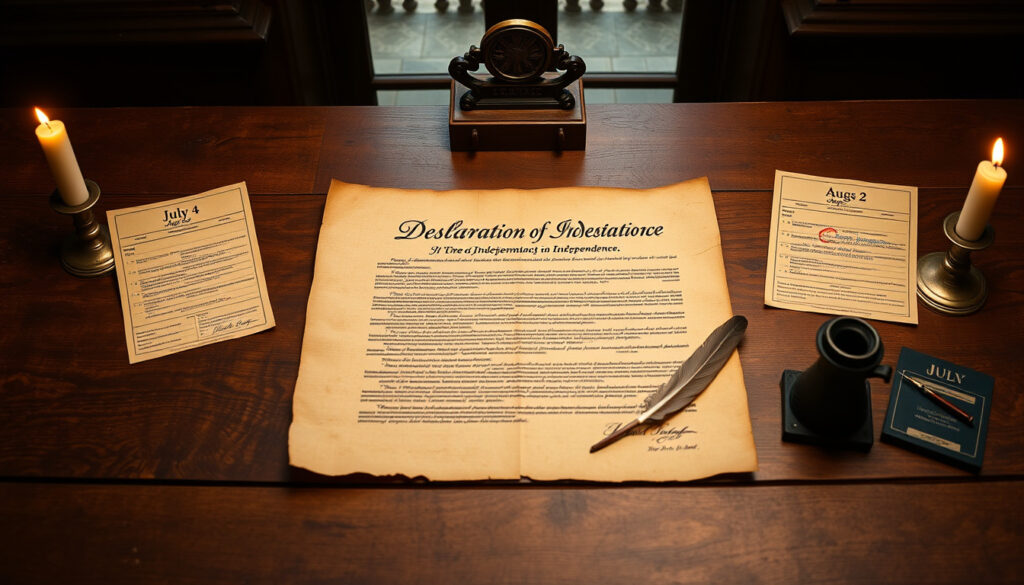
When Was the Declaration of Independence Signed – Adopted July 4, Signed August 2
The Declaration of Independence stands as one of the most significant documents in American history, yet confusion persists about when it was actually signed. Most Americans associate the signing with July 4, 1776, but the historical record tells a more complex story. Understanding the timeline of adoption and signing helps clarify this enduring historical misconception.
The Continental Congress approved the final text of the Declaration on July 4, 1776, but the formal signing by delegates occurred weeks later. This distinction matters for anyone studying early American history or seeking accurate information about the founding of the United States.
When Was the Declaration of Independence Signed?
The formal signing of the Declaration of Independence began on August 2, 1776, at Independence Hall in Philadelphia. This date marks when the majority of the 56 delegates signed the engrossed parchment version of the document. The common perception that all signatures were affixed on July 4 is a myth that historical evidence does not support.
July 4, 1776
August 2, 1776
56 delegates
Signed July 4
- The engrossed parchment was not ready until after July 19, 1776
- Delegates were not all present in Philadelphia on July 4
- The July 4 date on the document refers to adoption, not signing
- Thomas McKean signed last, after January 1777
- Seven people present on July 4 never signed the document
- John Hancock placed his signature prominently in the center of the document
| Fact | Date/Details |
|---|---|
| Adoption | July 4, 1776 |
| Engrossed on Parchment | July 19, 1776 |
| Signing Began | August 2, 1776 |
| Total Signers | 56 delegates |
| Location | Independence Hall, Philadelphia |
| Last Signer | Thomas McKean (after January 1777) |
When Was the Declaration of Independence Adopted by Congress?
The Continental Congress formally adopted the Declaration of Independence on July 4, 1776, following two days of debate on July 1-2. On that date, 12 of the 13 colonies voted to approve the resolution for independence, with New York abstaining. Congress immediately ordered the document printed, with John Dunlap tasked with producing approximately 200 broadside copies.
The Drafting Process
Thomas Jefferson drafted the initial text of the Declaration in mid-June 1776, working from ideas and phrases discussed in Congress. The Committee of Five—including Jefferson, John Adams, Benjamin Franklin, Robert R. Livingston, and Roger Sherman—reviewed and edited the draft before submitting it to Congress. Jefferson’s original draft underwent significant revisions, particularly in the section criticizing the British slave trade, a compromise reached to secure support from Georgia and South Carolina delegates.
On July 4, 1776, Congress approved the final wording and authorized immediate printing. These first printings, known as Dunlap Broadsides, included only John Hancock’s name as President of Congress. Of the approximately 200 copies printed on July 4, only 26 survive today. The first public reading occurred on July 8, 1776, when Colonel John Nixon read the document aloud in Philadelphia’s Independence Square.
The Engrossing Process
Congress ordered the Declaration engrossed on parchment on July 19, 1776, with an updated title: “The Unanimous Declaration of the Thirteen United States of America.” Timothy Matlack served as the engrossing clerk, carefully transcribing the final approved text onto the large parchment document that would become the official record. This engrossed version took time to complete, explaining why delegates could not sign on July 4.
The belief that the Declaration was signed on July 4 stems from several sources. Early writings by Jefferson, Franklin, and Adams referenced Independence Day celebrations, the prominent July 4 date printed on the document itself, and an entry in the 1777 Journals of the Continental Congress. These factors combined to cement July 4 as the signing date in American popular memory, even as historians generally agree that most signatures were actually added on August 2.
Who Signed the Declaration of Independence and in What Order?
Fifty-six delegates ultimately signed the Declaration of Independence, but not all signed on the same day or even in the same month. The signing process began on August 2, 1776, when approximately 50 delegates gathered to add their names to the engrossed parchment. Additional signers followed over the subsequent months, with the final signature added after January 1777.
The First Signature
John Hancock, President of the Continental Congress, signed first on August 2. His signature remains the most prominent on the document, placed in the center of the parchment and notably larger than those of his fellow delegates. While various theories exist about why Hancock signed so boldly—ranging from spite toward King George III to a desire for clear identification—historical records do not definitively explain this distinctive choice.
Order of Signatures
Signatures were arranged by state delegation, beginning with the northernmost colonies and proceeding southward to Georgia. This arrangement placed New Hampshire at the top right of the document, followed by Massachusetts Bay, Rhode Island, and the remaining states in geographic order. The signatures appeared in five columns, creating a visual representation of the unified colonies despite their regional differences.
| State | Selected Signers |
|---|---|
| New Hampshire | Josiah Bartlett, William Whipple, Matthew Thornton |
| Massachusetts Bay | John Hancock, Samuel Adams, John Adams |
| Rhode Island | Stephen Hopkins, William Ellery |
| Connecticut | Roger Sherman, Samuel Huntington, William Williams |
| New York | William Floyd, Francis Lewis, Philip Livingston |
George Washington and the Declaration
George Washington did not sign the Declaration of Independence. This fact often surprises those who assume he played a role in every founding moment of the nation. Washington was not a delegate to the Continental Congress in 1776; instead, he served as Commander-in-Chief of the Continental Army, directing military operations in New York at the time. His duties kept him in the field rather than in Philadelphia, where the political work of independence unfolded.
Many people believe George Washington signed the Declaration because of his central role in the American Revolution and the founding era. However, Washington was commanding forces in New York during the summer of 1776 and was not a member of the Continental Congress. The document was signed by 56 delegates from the Second Continental Congress, not by military leaders.
Late Signers and Those Who Never Signed
Several delegates signed the Declaration after August 2, 1776, including Richard Henry Lee, George Wythe, Elbridge Gerry, Oliver Wolcott, Lewis Morris, Thomas McKean, and Matthew Thornton. Thomas McKean of Delaware signed last, adding his name sometime after January 1777. Additionally, seven individuals who were present for the adoption vote on July 4 never signed the document at all, having left Philadelphia or been replaced before the signing ceremonies occurred.
The Timeline of Key Events
Understanding the sequence of events leading to the Declaration’s signing provides essential context for interpreting this founding document. The following timeline captures the major milestones from the independence resolution to the completion of the signing process.
- June 7, 1776: Richard Henry Lee introduces the resolution for independence in the Continental Congress
- June 10, 1776: Congress postpones consideration of the independence resolution to July 1
- June 11, 1776: Committee of Five appointed to draft the Declaration
- July 1-2, 1776: Congress debates independence; 12 colonies approve (New York abstains)
- July 2-4, 1776: Debates and revisions to the Declaration text continue; final approval given
- July 4, 1776: Congress approves final draft; John Dunlap prints approximately 200 broadsides
- July 8, 1776: First public reading by Colonel John Nixon in Independence Square
- July 19, 1776: Congress orders Declaration engrossed on parchment
- August 2, 1776: Signing begins; approximately 50 of 56 delegates sign
- After August 2, 1776: Remaining delegates add signatures through January 1777
What We Know for Certain and What Remains Unclear
Historical research has established certain facts about the Declaration’s signing while leaving other details uncertain or subject to ongoing scholarly debate.
| Established Information | Information That Remains Unclear |
|---|---|
| Adopted July 4, 1776 | Exact time of day for signing ceremonies |
| Signing began August 2, 1776 | Whether Hancock signed before or after others on August 2 |
| 56 total delegates signed | Precise order of signatures within state delegations |
| John Hancock signed first | Exact dates for several late signers |
| Thomas McKean signed last | Whether some delegates who left returned specifically to sign |
| Washington did not sign | Whether August 2 was a single ceremony or spanned multiple days |
The surviving engrossed parchment of the Declaration of Independence is housed at the National Archives in Washington, D.C. This document, handwritten by Timothy Matlack and bearing the signatures of 56 delegates, serves as the definitive original record of the signers and their commitment to American independence.
Why the Signing Date Matters
The distinction between adoption on July 4 and signing on August 2 carries historical significance beyond mere calendar precision. July 4 marks the moment when the Continental Congress formally committed the unified colonies to independence from Great Britain, transforming revolutionary sentiment into official political action. August 2 represents the completion of that commitment, as individual delegates affixed their names to the document and assumed the personal risks it entailed.
The engrossed parchment bearing the 56 signatures became the official record of this commitment, replacing the earlier printed broadsides that lacked delegate signatures. By signing, each delegate not only endorsed the Declaration’s principles but also personally declared themselves traitors to the British Crown—a risk that made the signatures of 1776 genuinely heroic acts. The signing ceremonies transformed a congressional resolution into a collective covenant among the delegates and the states they represented.
“We must hang together, or most assuredly we shall hang separately.” — Benjamin Franklin, during the signing deliberations
Summary
The Declaration of Independence was adopted by the Continental Congress on July 4, 1776, but the formal signing by delegates occurred beginning on August 2, 1776, and continued for several months thereafter. Fifty-six delegates ultimately signed the engrossed parchment document, with John Hancock signing first in the center and Thomas McKean signing last after January 1777. George Washington did not sign the Declaration, as he was serving as Commander-in-Chief of the Continental Army rather than attending Congress in Philadelphia. The common belief that all signings occurred on July 4 reflects a persistent historical myth that the documented evidence does not support. Understanding this timeline helps clarify one of American history’s most enduring misconceptions while appreciating the genuine courage of the 56 delegates who riskily pledged their “Lives, Fortunes and sacred Honor” to the cause of independence.
For related historical content, see our guide on Social Security Fairness Act Payments – What to Expect or USA Men’s Hockey Next Game – No 2024 Games, Olympics 2026.
Frequently Asked Questions
When was the Declaration of Independence officially signed?
The formal signing began on August 2, 1776, when most of the 56 delegates signed the engrossed parchment version. Some delegates signed later, with the final signature added after January 1777.
Did all 56 delegates sign on the same day?
No. Approximately 50 delegates signed on August 2, 1776. The remaining delegates signed over the following months, with Thomas McKean adding the final signature after January 1777.
Who was the first person to sign the Declaration of Independence?
John Hancock, President of the Continental Congress, signed first on August 2, 1776. His signature appears prominently in the center of the document, notably larger than those of the other signers.
Did George Washington sign the Declaration of Independence?
No. George Washington was not a delegate to the Continental Congress in 1776. He was serving as Commander-in-Chief of the Continental Army, directing military operations in New York during the summer of 1776.
Why do most Americans believe the Declaration was signed on July 4?
The July 4 misconception stems from several factors: the document’s own date marking adoption, early writings by founders like Jefferson and Adams, and the 1777 Journals of the Continental Congress. Most historians agree the actual signing began August 2.
How many copies of the Declaration were printed on July 4?
John Dunlap printed approximately 200 copies of the Declaration on July 4, 1776. These broadsides included only Hancock’s name. Of the estimated 200 copies printed, only 26 survive today.
What is the engrossed parchment of the Declaration?
The engrossed parchment is the official handwritten copy of the Declaration of Independence, transcribed by Timothy Matlack and ordered by Congress on July 19, 1776. This document bears the 56 signatures and is preserved at the National Archives.
Were there delegates present on July 4 who never signed?
Yes. Seven individuals who attended the Continental Congress on July 4, 1776, and participated in the adoption of the Declaration never signed the engrossed parchment, having departed Philadelphia or been replaced before the signing ceremonies.
More related posts
 Beckwith-Wiedemann Syndrome (BWS): Causes, Symptoms, Life Expectancy
 My Hero Academia Season 7: Status, Streaming & Future Seasons
 Trust in God Lyrics: Elevation Worship, Hillsong, Chords
 How to Make Friends: Easy Steps for Adults and Introverts
 Buffy the Vampire Slayer Movie: Canon, Ca t & Guide
 La Boo-Boo – The Truth About Labubu’s Name Origin
 As It Was Lyrics – Meaning, Facts and Harry’s House
 Self Service Car Wash: Ireland Guide, Prices & Locations