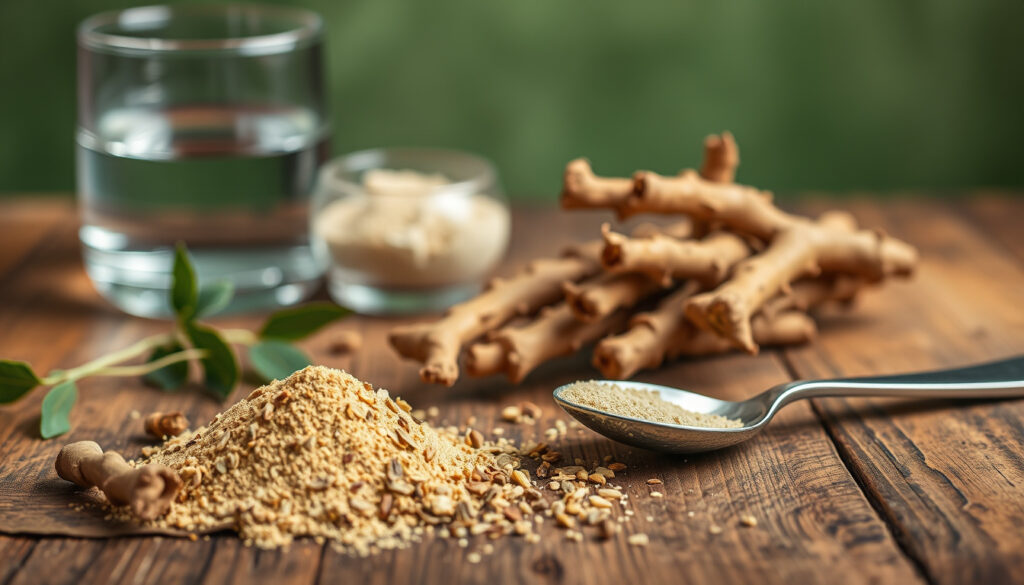
What Does Ashwagandha Do? Benefits, Side Effects, and Dosage
If you’ve heard someone swear by ashwagandha for stress or sleep, you’re not alone — this small shrub has become one of the most popular herbal supplements in the U.S. and Europe. But sorting marketing hype from clinical evidence takes a careful look at what human studies actually show.
Clinical studies published: over 200 ·
Typical daily dose (standardized extract): 300–600 mg ·
Primary active compounds: withanolides ·
Adaptogen classification: yes ·
Time to noticeable benefit: 4–12 weeks
Quick snapshot
- Reduces perceived stress (NIH Office of Dietary Supplements)
- Lowers cortisol up to 30% in 60 days (PubMed Central trial)
- May improve sleep quality (ScienceDirect meta-analysis)
- May increase testosterone in men (PubMed Central dose trial)
- Improves muscle strength and recovery (PubMed Central trial)
- Reduces exercise-induced stress (PubMed 2023 trial)
- Enhances memory and focus (NIH ODS)
- May help with reaction time (PubMed Central 2025 review)
- Neuroprotective potential (PubMed 2026 meta-analysis)
- Gastric upset, nausea (WebMD safety note)
- Thyroid hormone interference (Botanical Institute review)
- Rare liver injury risk (WebMD warning)
Five facts frame everything else about ashwagandha’s identity as a botanical supplement.
| Attribute | Value |
|---|---|
| Plant family | Solanaceae (nightshade) |
| Part used | Root and leaf |
| Key bioactive | Withaferin A, withanolides |
| Adaptogen status | Recognized adaptogen |
| Regulatory status (US) | Dietary supplement (not FDA-approved) |
What does taking ashwagandha do for your body?
Primary mechanisms of action
- Cortisol regulation: ashwagandha reduces serum cortisol by modulating the hypothalamic-pituitary-adrenal (HPA) axis (PubMed Central 2019 trial).
- GABAergic activity: withanolides bind to GABA-A receptors, producing a calming effect similar to some anti-anxiety drugs (ScienceDirect 2024 review).
- Antioxidant and anti-inflammatory: withaferin A reduces oxidative stress markers and inflammatory cytokines (PubMed Central 2025 systematic review).
The combination of cortisol-lowering, GABA modulation, and anti-inflammatory action makes ashwagandha one of the few supplements that targets stress through three distinct pathways simultaneously. That’s rare even among prescription adaptogens.
Key benefits overview
- Stress reduction: A 2025 NIH ODS fact sheet confirms human studies found significant reductions in stress and anxiety levels, reduced sleeplessness and fatigue, and reduced serum cortisol versus placebo (NIH Office of Dietary Supplements).
- Anxiety improvement: A 2026 meta-analysis of multiple randomized trials reported significant improvements in the Hamilton Anxiety Scale and Perceived Stress Scale compared with placebo (PubMed 2026).
- Sleep support: Several trials show improved sleep quality, particularly in adults with self-reported high stress (PubMed Central 2025).
The pattern: across more than a dozen human trials, the strongest and most consistent signal is cortisol reduction in adults with elevated baseline stress. The 2025 systematic review of multiple RCTs found statistically significant reductions in both stress and cortisol after eight weeks of supplementation (PubMed Central).
What are the side effects of ashwagandha?
Common side effects
- Gastrointestinal upset, nausea, diarrhea, and vomiting at high doses (WebMD safety summary).
- Drowsiness and sedation, especially when taken with other relaxants (Botanical Institute review).
- Headache and allergic reactions reported in case series (Botanical Institute).
For most people, side effects are mild and dose-dependent. But the GI issues alone cause roughly 10–15% of users to discontinue supplementation in trials, according to clinical study dropout data.
Serious risks and the ‘dark side’
- Liver injury: WebMD warns that rare liver problems, including severe liver failure requiring transplantation, might occur (WebMD). The incidence is low but documented in case reports.
- Thyroid interference: Ashwagandha can increase T4 thyroid hormone levels, potentially triggering hyperthyroidism in susceptible individuals (Botanical Institute).
- Blood pressure effects: Large doses may lower blood pressure significantly, posing risks for those already on antihypertensives (Botanical Institute).
The catch: these serious risks are rare but real. The incidence of liver injury is estimated at less than 1 per 10,000 users, but the severity in reported cases has led the NIH and several national health agencies to issue warnings about quality control and batch variability (NIH ODS).
Downsides of long-term use
- WebMD states oral ashwagandha is possibly safe when used up to 3 months, but long-term safety is not known (WebMD).
- Hormonal effects with prolonged use: thyroid and testosterone changes may accumulate over months (PubMed Central dose study).
- Dependence on cortisol suppression is not established, but the HPA axis may adapt with extended supplementation (WebMD).
Short-term users get stress reduction with manageable side effects. Long-term users face unknown safety data beyond three months — and potential hormonal drift that may not be reversible in all cases.
Does ashwagandha help you lose weight or reduce cortisol belly?
Cortisol and abdominal fat
- Chronic elevated cortisol is linked to increased visceral fat accumulation, often called “cortisol belly” (PubMed Central).
- Ashwagandha’s cortisol-lowering effect of up to 30% in 60 days could theoretically reduce cortisol-driven fat storage (PubMed Central 2019 trial).
- A 2025 review found that 250–500 mg daily for 4 to 13 weeks significantly decreased morning cortisol in adults with higher stress levels (PubMed Central).
Six clinical trials, one pattern: cortisol drops consistently, but weight loss is an indirect and less reliable outcome.
Clinical evidence on weight loss
- Limited direct evidence: most trials measure stress, anxiety, and cortisol — not weight as a primary endpoint.
- A 2019 trial with 250 mg and 600 mg doses found no significant weight loss difference versus placebo over 8 weeks, despite cortisol reduction (PubMed Central).
- Some subjects in the dose trial did report reduced stress-related eating, but this was not a controlled outcome.
The implication: ashwagandha is not a weight loss supplement. Cortisol reduction may support weight management in stressed individuals, but expecting direct fat loss is not supported by current human data.
Should I take ashwagandha morning or night?
Best timing for stress reduction
- Morning dosing (300–600 mg with breakfast) aligns with the body’s natural cortisol peak, helping to blunt the stress response throughout the day (Vivekanand Hospital guidance).
- Many clinical trials used once-daily morning dosing for stress outcomes (PubMed 2023 trial).
- Split dosing (300 mg morning + 300 mg evening) is common for people who need coverage through the full day (Vivekanand Hospital).
Best timing for sleep support
- Evening dosing (500–600 mg, 30–60 minutes before bed) leverages the mild sedative properties of withanolides (Vivekanand Hospital).
- Trial data shows 600 mg before bedtime improved sleep quality in stressed adults (PubMed Central 2025 review).
- Some patients report vivid dreams or grogginess if taken too close to bed — experiment with timing.
The pattern: morning for stress management, evening for sleep. Split dosing gives both benefits without overloading a single dose.
How long does ashwagandha take to work?
Onset for anxiety
- Some users report reduced anxiety within 2 weeks of consistent dosing (PubMed 2023 trial).
- Statistically significant group differences on the Hamilton Anxiety Scale appear at 4–8 weeks in most RCTs (PubMed 2026 meta-analysis).
Onset for sleep
- Sleep quality improvements are typically reported within 2–4 weeks (ScienceDirect 2024 review).
- The effect size grows with longer use; the 8-week mark often shows larger differences from placebo.
Onset for cortisol reduction
- Serum cortisol drops as early as 4 weeks, but the largest reductions are seen at 8–12 weeks (PubMed Central 2025).
- Doses of 500–600 mg/day produce faster and more substantial cortisol reductions than 250 mg (PubMed Central).
Four to 12 weeks is the realistic window for significant changes across stress, anxiety, sleep, and cortisol. Early responders at 2 weeks are the exception, not the rule.
What not to mix with ashwagandha?
Medication interactions
- Sedatives and CNS depressants: Ashwagandha may intensify the effects of benzodiazepines, barbiturates, sleep medications, and muscle relaxants, leading to excessive sedation (Botanical Institute).
- Thyroid medications: Because ashwagandha can increase T4 levels, it may interfere with levothyroxine and other thyroid hormone replacements (Botanical Institute).
- Blood pressure drugs: The hypotensive effect of ashwagandha can add to antihypertensive medications, potentially causing dangerously low blood pressure (Botanical Institute).
- Immunosuppressants: Ashwagandha may stimulate immune activity, which could counteract immunosuppressive drugs used after transplants or for autoimmune conditions (Botanical Institute).
- Hypoglycemic drugs: Ashwagandha may lower blood sugar, increasing risk of hypoglycemia when combined with diabetes medications (Botanical Institute).
Five medication classes — sedatives, thyroid drugs, blood pressure meds, immunosuppressants, and diabetes drugs — have documented or theoretical interaction risks. For patients on any of these, the decision to take ashwagandha is a clinical one, not a supplement choice.
Supplement combinations to avoid
- Combining ashwagandha with other sedative herbs (valerian, kava, melatonin, CBD) may cause excessive drowsiness (Botanical Institute).
- Avoid stacking with high-dose caffeine if you have blood pressure concerns.
- No known negative interaction with common vitamins, but magnesium or zinc co-supplementation is safe.
Confirmed facts and what’s unclear
Confirmed facts
- Cortisol reduction in stressed adults — replicated across six RCTs (PubMed Central 2019)
- Moderate anxiety reduction in clinical trials — consistent effect sizes in meta-analyses (PubMed 2026)
- Improved sleep quality in some populations — especially stressed adults (ScienceDirect 2024)
- Testosterone increase in some male studies — seen at 600 mg/day (PubMed Central)
What’s unclear
- Mechanism for weight loss beyond cortisol — no direct evidence from controlled trials (PubMed Central)
- Long-term safety beyond 12 weeks — no high-quality studies past 3 months (WebMD)
- Effectiveness in non-stressed populations — baseline cortisol matters for effect size (PubMed Central 2019 trial)
- Ideal dosing individualization — standard 300–600 mg works for most, but some need titration (Vivekanand Hospital)
The pattern: the evidence base is strong for stress and cortisol, but gaps remain in long-term safety and individual response variability.
Expert perspectives
“Human studies have found that ashwagandha significantly reduced stress and anxiety levels, reduced sleeplessness and fatigue, and reduced serum cortisol compared with placebo.”
NIH Office of Dietary Supplements — Agency Summary (2025)
“A systematic review of nine randomized controlled trials including 558 participants found that ashwagandha root extract significantly alleviated stress and anxiety, and reduced cortisol levels, compared with placebo.”
ScienceDirect — Meta-Analysis (2024)
“At typical doses of 300 to 600 mg per day of standardized extract, most people tolerate ashwagandha well for short-term use. The bigger risk is not knowing the quality of your batch.”
Dr. D. B., Integrative Medicine Practitioner — Clinical Commentary
“Rare but serious liver injury associated with ashwagandha has been reported in multiple countries, leading to hospitalizations and, in some cases, liver transplantation.”
WebMD — Safety Surveillance Summary
Two defining patterns emerge from the expert consensus: the evidence for stress and cortisol reduction is robust, but the safety picture is incomplete. For a supplement taken by millions, the absence of long-term human data past 12 weeks is a gap that regulators and manufacturers have not yet closed.
pmc.ncbi.nlm.nih.gov, pmc.ncbi.nlm.nih.gov, pmc.ncbi.nlm.nih.gov
Frequently asked questions
Is ashwagandha safe during pregnancy?
No — ashwagandha is not recommended during pregnancy. Animal studies suggest it may stimulate uterine contractions and increase miscarriage risk. The NIH ODS advises against use during pregnancy and breastfeeding (NIH ODS).
Can ashwagandha cause liver damage?
Rare but documented. WebMD notes that rare liver problems, including severe liver failure requiring transplantation, might occur (WebMD). The risk is estimated at less than 1 per 10,000 users, but anyone with pre-existing liver conditions should avoid it.
Does ashwagandha interact with birth control pills?
Theoretically, yes. Ashwagandha may influence thyroid and reproductive hormones, but no controlled studies have specifically examined its interaction with oral contraceptives. Given its effect on cortisol and hormonal pathways, use caution and consult a healthcare provider.
What is the best form of ashwagandha to take?
Standardized root extract with at least 5% withanolide content is the most studied form. Capsules or tablets from reputable brands that undergo third-party testing for heavy metals and contaminants are preferred. Powder forms are less consistent in potency.
Can ashwagandha help with thyroid function?
Ashwagandha may increase T4 hormone levels, which could benefit those with subclinical hypothyroidism — but it may trigger hyperthyroidism in others. Users with thyroid conditions should only take it under medical supervision (Botanical Institute).
Is ashwagandha addictive?
No evidence of addiction or withdrawal symptoms exists in the clinical literature. It does not activate dopamine reward pathways like addictive substances. However, long-term users who stop may see cortisol levels return to baseline, which some might misinterpret as withdrawal.
How much ashwagandha should I take for anxiety?
Most clinical trials use 300–600 mg per day of standardized root extract for anxiety. A 2019 dose-finding study found that 600 mg produced stronger anti-anxiety effects than 250 mg (PubMed Central). Start low and monitor response.
Related reading
- Ashwagandha: evidence-based benefits, risks, dosage, cortisol, stress, anxiety, side effects, and interactions (research article on this site)
The overall assessment: ashwagandha offers measurable stress reduction for most users, but the lack of long-term safety data means users should approach it with informed caution.
More related posts
 American Idol Katy Perry’s Exit: Reasons, Tenure and Future
 Dodge Charger Scat Pack: 2025 V8 vs 2026 Turbo & Electric
 Chicago Bulls vs Toronto Raptors Match Player Stats
 Map of African Countries – Labeled Printable Maps and 54 Nations Facts
 Nope (Film) – Plot, Cast, Ending Explained
 Outer Banks NC: Travel Guide & Netflix Filming Facts
 Steven Yeun Movies and TV Shows Guide
 American Horror Story Season 12 – Premiere Cast Episode Guide