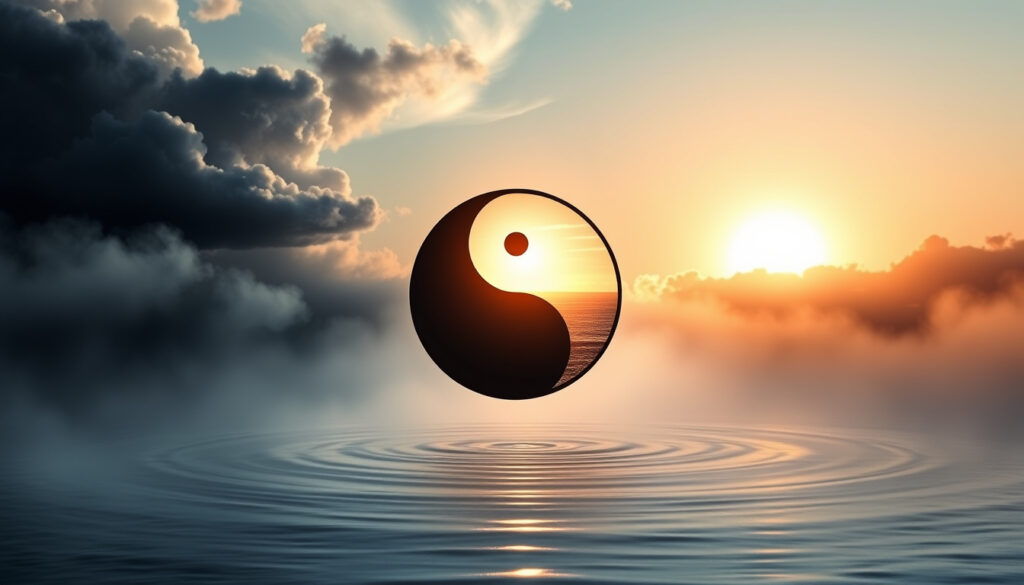
Yin and Yang Meaning: Symbolism, Balance, and Clarity
You’ve probably seen the black-and-white swirl on jewelry, tattoos, or a friend’s phone case, and wondered what yin and yang actually mean beyond “balance.” It’s a concept that predates the Tao Te Ching by centuries, yet it still gets flattened into internet quizzes that ask whether you’re more “yin” or “yang.”
Origin: Ancient Chinese philosophy ·
Yin: Earth, dark, receptive ·
Yang: Heaven, light, active ·
Symbol name: Taijitu ·
Core principle: Complementary forces in dynamic balance
Here is a quick reference table summarizing the key attributes of yin and yang.
| Attribute | Yin | Yang |
| Nature | Dark, receptive, earth | Light, active, heaven |
| Direction | Inward, contracting | Outward, expanding |
| Energy | Rest, stillness | Movement, dynamism |
| Element | Water, earth | Fire, air |
| Gender association | Feminine | Masculine |
Quick snapshot
- Dark, receptive, earth, rest (Britannica)
- Light, active, heaven, movement (Britannica)
- Two swirling halves with a dot of the opposite color in each side (Chinese Fortune Calendar)
- Complementary, not opposing; a high phase follows a low phase (The Sun)
| Origin | Ancient Chinese philosophy |
| Yin associations | Earth, darkness, receptivity |
| Yang associations | Heaven, light, activity |
| Popular symbol | Taijitu (black-and-white swirl) |
| Core rule | Opposites are complementary and interdependent |
What do yin and yang symbolize?
Yin and yang are two complementary forces that make up all aspects and phenomena of life, according to Britannica (encyclopedia reference). They interact, interconnect, and perpetuate each other—not as absolute opposites, but as relational phases that shift continuously.
What is the yin-yang symbol called?
- The popular symbol is the taijitu: two swirling halves with a dot of the opposite color in each side (Chinese Fortune Calendar).
- It represents opposite qualities in all phenomena and beings, rather than absolute opposites separated from one another (Chinese Fortune Calendar).
What does the dot of the opposite color mean?
The dot in each half shows that nothing is purely yin or purely yang—within the darkest yin lies the seed of yang, and vice versa. A University of Washington educational page describes the symbol as representing opposing principles in the universe, embedded in many zodiacs (University of Washington educational resource).
The implication: the symbol is a process diagram, not a snapshot. It tells you that every phase carries its opposite within it, which is why the two forces never resolve into one “winner.”
Is Yin considered positive or negative?
In classical yin-yang thought, yin is not “negative” in a moral sense—the two forces are relational rather than a value judgment. Britannica (encyclopedia reference) notes that yin is the dark, still, receptive phase; yang is the bright, active phase. The pairing is descriptive, not evaluative.
What is the dark side of yin and yang?
The “dark side” of yin refers to shadow, night, and rest—not to evil. Britannica associates yin with darkness, passivity, and absorption (Britannica). The contrast is between phases of activity and receptivity, not between good and bad.
Do yin and yang mean good and evil?
No. The core definition treats yin and yang as complementary, not as a moral dualism (Chinese Fortune Calendar). The concept explains balance and mutual dependence rather than a fixed moral framework.
Why this matters: when someone reads yin as “negative,” they import a Western moral lens onto a Chinese cosmological model. The original idea has no villain.
Is Yin or yang female energy?
Yin is traditionally read as feminine or receptive energy; yang is traditionally read as masculine or active energy. Britannica explicitly lists femaleness with yin and maleness with yang—but these are cultural analogies, not fixed biological categories.
Which is female energy: yin or yang?
In the symbol, yin is the dark side and yang is the light side. A Reddit r/taoism thread asks why black is female and white is masculine—a common point of confusion because the associations seem arbitrary until you understand yin as earth and receptive, yang as heaven and active (Reddit r/taoism community discussion).
Is yin considered feminine or masculine?
Yin is the feminine-coded side; yang is the masculine-coded side (Shinkofa Chinese astrology resource). Popular explanations also connect yin with receptivity and intuition and yang with giving and logic (The Sun Ireland).
The catch: these gendered labels are analogies drawn from nature—earth receives, heaven acts—not prescriptions for how men and women should behave. A person or situation can be yin in one context and yang in another.
How do I know if I am Yin or yang?
In classical yin-yang thought, no person is purely one force; both forces exist in everything (Britannica). The question “am I yin or yang?” assumes a fixed identity that the philosophy doesn’t support.
What personality traits are associated with yin and yang?
Yin traits are often described as restful, receptive, cool, and introspective; yang traits as active, assertive, warm, and outward (The Sun). These descriptions come from the elemental associations: yin as earth and absorption, yang as heaven and penetration (Britannica).
Do yin-yang personality quizzes reflect classical philosophy?
Personality quizzes that label a person as “yin” or “yang” simplify a situational cosmic principle into a fixed identity (The Sun). The original concept describes phases and relationships in situations, not immutable character types.
The pattern: if you’re drawn to one label, you’re probably describing a preference or a phase—not a permanent cosmic assignment. The philosophy asks you to hold both, in dynamic tension.
How do I harness yin and yang for mental peace and clarity?
Yin-yang philosophy describes a dynamic rhythm: rest follows activity, and calm follows stress (Chinese Fortune Calendar). Mental peace is framed as recognizing and honoring both active and restful phases, rather than pushing one into the background.
How does balance relate to mental peace?
Balance doesn’t mean a 50/50 split—it means letting each phase complete itself. A high phase is followed by a low, and movement is followed by rest (Chinese Fortune Calendar). Trying to stay in “yang mode” all day is like asking the sun to never set.
What are simple yin-yang balance practices?
- Alternate focused work with deliberate rest—set a timer for 25 minutes of yang output, then 5 minutes of yin recovery.
- Create a daily rhythm that mirrors yin-yang alternation: morning activity, midday pause, evening wind-down (Chinese Fortune Calendar).
- When you feel stuck in overdrive, schedule a literal dark, quiet hour—yin’s domain—to let the cycle reset.
The trade-off: honoring yin means accepting periods of low output. That feels counterproductive in a productivity-obsessed culture, but the philosophy suggests the rest is what makes the activity sustainable.
What zodiac signs are yin and yang?
The Chinese zodiac uses yin and yang as a classification principle alongside the five elements and twelve earthly branches (Chinese Fortune Calendar). The twelve zodiac animals are split into yin and yang groups by the polarity of their earthly branches.
How does the Chinese zodiac assign yin and yang?
Chinese zodiac systems map the 12 earthly branches to alternating yin and yang classifications (Chinese Fortune Calendar). The sequence alternates starting with Yang Rat, then Yin Ox, Yang Tiger, Yin Rabbit, and so on.
Which zodiac signs are yang?
The traditional assignment divides animals into yin and yang groups based on the polarity of their earthly branches.
| Yang signs | Yin signs |
| Rat | Ox |
| Tiger | Rabbit |
| Dragon | Snake |
| Horse | Goat |
| Monkey | Rooster |
| Dog | Pig |
This mapping comes from the earthly branches’ polarity, not from personality traits. A specialist resource notes that planets, days, months, and states can be designated yin or yang in Chinese cosmology (Sino-Platonic Papers academic journal).
What this means: your zodiac sign’s yin or yang label is a structural position in a cycle, not a personality verdict. It tells you about the branch’s polarity, not about your temperament.
Are yin and yang disrespectful?
The yin-yang symbol is widely used as a Chinese philosophical and Taoist symbol, not as a closed religious icon (University of Washington educational resource). The cultural-sensitivity discussion centers on context: decorative use is common, but meaning should not be separated from its Taoist or Chinese origin.
Is wearing yin-yang jewelry cultural appropriation?
There’s no single authoritative rule, but the concern arises when the symbol is stripped of its Taoist context and treated as a generic “balance” logo (University of Washington). The symbol remains a living part of Chinese philosophy and religious practice, so wearing it carries a responsibility to understand what it means.
How can the yin-yang symbol be used respectfully?
Respectful use focuses on accurate explanation and avoiding shallow misrepresentation of the original meaning (Chinese Fortune Calendar). If you wear it or share it, know the history—and be ready to correct the “good vs. evil” misreading.
The catch: the symbol is accessible, but its meaning is specific. The people who object to misuse usually aren’t objecting to outsiders engaging with the philosophy—they’re objecting to a symbol being flattened into a wellness aesthetic.
The yin-yang symbol travels across cultures easily, but its meaning gets diluted with every move. Keep the Taoist origin attached, or you’re just wearing a geometric pattern.
Confirmed facts
- Yin-yang originated in ancient Chinese philosophy (Britannica).
- Yin and yang describe complementary rather than hostile forces (Britannica).
- Yin is associated with earth, dark, and receptive qualities; yang with heaven, light, and active qualities (Britannica).
- The Chinese zodiac divides its 12 animals into yin and yang groups (Chinese Fortune Calendar).
What’s unclear
- Whether an individual person “is” yin or yang is not fixed in classical philosophy; the forces describe phases and relationships in situations.
- Whether using the yin-yang symbol as decoration is culturally disrespectful depends on context and intent; no single authoritative rule exists.
- Whether yin-yang balance means equal time for each phase is debated – classical sources emphasize dynamic alternation, not equal duration.
- Whether wearing yin-yang jewelry is always respectful remains contested; some argue it can be done respectfully with proper understanding, while others see it as inherently appropriative.
“Yin and yang are the two complementary forces that make up all aspects and phenomena of life.”
Britannica encyclopedia reference
“A high phase is followed by a low, and movement is followed by rest.”
“Yin-yang is a core concept of Taoism and Chinese philosophy, representing opposing principles in the universe.”
Yin and yang are not a personality test or a moral code—they’re a description of how phases interact. For anyone trying to apply this philosophy to daily life, the choice is clear: stop asking which one you are and start asking which phase you’re in, and what needs to follow.
shinkofa.com, thesun.ie, chinesezodiac.com, aj.xhu.edu.cn, shunspirit.com, beau-life.com
Frequently asked questions
What does yin and yang mean in life?
In life, yin and yang mean that every situation contains complementary phases—activity and rest, light and dark, growth and contraction. The philosophy asks you to recognize both and let them alternate naturally (Britannica).
What does yin and yang mean in love?
In relationships, yin and yang describe the dynamic between giving and receiving, initiating and responding. The balance isn’t about one person being “yin” and the other “yang”—it’s about both partners moving through both phases (The Sun).
What does yin and yang mean in friendship?
In friendship, yin and yang show up as the alternation between supporting and being supported, listening and speaking. A healthy friendship lets both people occupy both roles at different times (Shinkofa).
What does yin and yang mean spiritually?
Spiritually, yin and yang describe the interdependence of opposites—wholeness arising from two halves that together complete a whole (The Sun). It’s a Taoist frame for seeing unity in apparent duality.
What is the difference between yin and yang?
Yin is associated with earth, darkness, passivity, and absorption; yang with heaven, light, activity, and penetration (Britannica). They’re not opposites in a hostile sense—they’re complementary phases.
Can a person be both yin and yang?
Yes—classical thought holds that both forces exist in everything, including every person (Britannica). The question is about your current phase, not your fixed identity.
More related posts
 Michael B. Jordan Filmography: Complete Guide to Movies & TV
 Is Super Mario Maker 2 Still Worth Buying in 2026
 Movies with Michael Peña: Best Films, New Series & Biography
 What Is a Sleeper Cell? Definition, News, and Key Sources
 Pizza Places Near Me – Top Ratings, Delivery and Local Spots
 Zelda Breath of the Wild: Playtime, Platforms & Guide
 Windows Media Creation Tool: Download, USB & Upgrade Guide