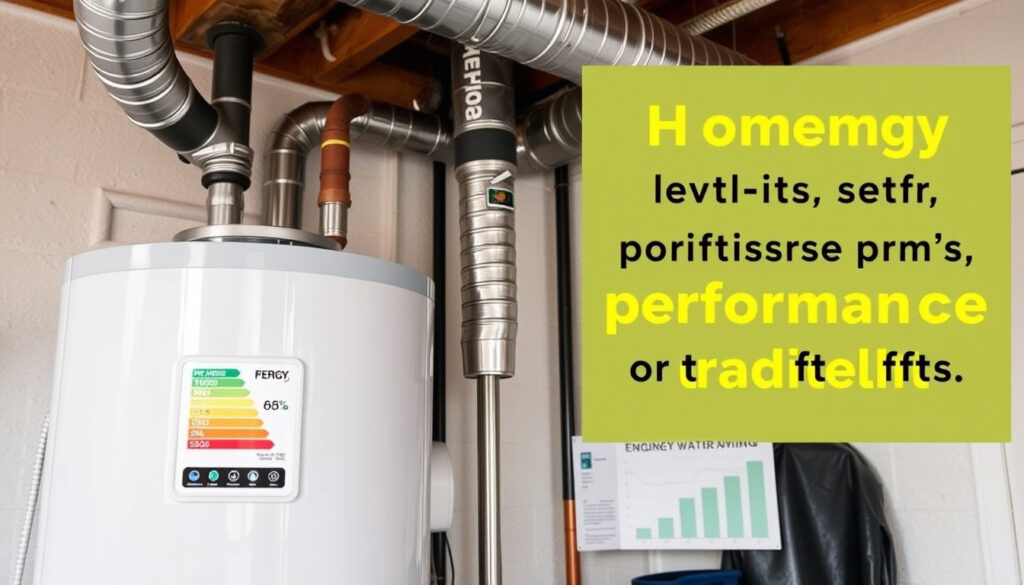
Heat Pump Water Heater: Worth It? Costs & Downsides
The numbers are shocking when you compare a standard electric immersion heater to a heat pump water heater: the first uses 3–4 kW per hour, while the second can cut costs by up to 75%. This guide breaks down how they work, what they cost, and whether they make sense for an Irish household.
Typical COP: 3 to 4 ·
Reduction in water heating costs vs. electric resistance: Up to 75% ·
Average installed cost in Ireland: €2,500 – €4,000 ·
Lifespan: 10–15 years ·
SEAI grant available: Up to €3,500
Quick snapshot
- Heat pump water heaters are more efficient than electric resistance (SEAI – Ireland’s energy authority)
- They operate effectively in Irish winter conditions (Daikin Ireland – heat pump manufacturer)
- Exact payback period varies by household usage (SEAI – Grant Scheme Operating Rules PDF)
- Long-term reliability of current models remains unproven in the Irish market (SEAI – Grant Scheme Operating Rules PDF)
- From 3 February 2026, the maximum heat pump system grant reportedly increased to €12,500 (Daikin Ireland – announcement)
- Adoption in Ireland is expected to rise as SEAI grants and home energy upgrades become more accessible (SEAI – grant programme)
Here are the key numbers for heat pump water heaters in Ireland.
| Metric | Value |
|---|---|
| Typical COP | 3–4 |
| Annual CO₂ savings vs. electric (4-person home) | ~1.5 tonnes |
| Average installed cost in Ireland | €2,500 – €4,000 |
| Lifespan | 10–15 years |
| SEAI grant cap | €3,500 |
| Minimum operating temperature | −15°C to −20°C (most models) |
| Power input (typical) | 500–1000 W |
Are heat pump water heaters worth it?
For many Irish homeowners, the first question is whether the higher upfront cost pays off. The short answer is yes, if you stay long enough to recoup the investment through lower running costs.
What are the long-term savings?
A heat pump water heater can cut water heating costs by up to 75% compared to a standard electric immersion element. According to SEAI (Ireland’s national energy authority), a typical four-person household could save about 1.5 tonnes of CO₂ per year – and a corresponding amount on their electricity bill.
The payback period is usually between 5 and 8 years, depending on your hot water usage and electricity tariff. With electricity prices in Ireland hovering around €0.30–€0.40 per kWh, every unit of heat you get from the air instead of the grid adds up.
For a family of four, the annual saving on water heating can exceed €300. Over 10 years, that’s €3,000 – enough to cover more than half the installed cost before grants.
How do they compare to traditional water heaters?
Electric immersion heaters are simple and cheap to buy, but they convert nearly all electricity directly into heat – a 1:1 ratio. A heat pump water heater, by contrast, delivers 3 to 4 units of heat for every unit of electricity it consumes. That’s the coefficient of performance (COP) you see in the specs.
Gas combi boilers are more efficient than immersion but still less efficient than a heat pump, and they produce on-site emissions. Heat pump water heaters use electricity from the grid, which is increasingly renewable in Ireland. SEAI’s operating rules note that supplementary hot water heaters must provide stored water at 60°C and prevent legionella – a standard that heat pump cylinders meet.
What grants are available?
SEAI offers grants for heat pump systems, including dedicated water heating units. As of early 2025, the standard grant for an air-to-water heat pump system is €6,500 for houses and €4,500 for apartments, according to NEA (National Energy Association – grant FAQ). However, from 3 February 2026, the maximum heat pump system grant is set to increase to €12,500, as reported by Daikin Ireland – that total includes up to €6,500 for the heat pump installation, up to €2,000 for central heating upgrades, and up to €4,000 as a renewable heat bonus.
To qualify, your home must have been built and occupied before 2021, and you must use a registered installer. Daikin’s grant guidance also states that the house must have a Heat Loss Indicator of ≤2 W/K/m² – meaning decent insulation is a prerequisite.
The implication: for those who stay put, the upfront cost is offset by long-term savings.
What does a heat pump water heater do?
Understanding the technology helps you evaluate whether it’s right for your home. It’s not magic – it’s thermodynamics.
How does a heat pump water heater extract heat from the air?
It works like a refrigerator in reverse. A fan draws in ambient air – even cold air still contains heat energy – and passes it over a coil filled with refrigerant. The refrigerant evaporates at a low temperature, absorbing heat from the air. A compressor then pressurises the vapour, raising its temperature further, and that hot gas flows through a heat exchanger wrapped around the water tank. The heat transfers to the water, the refrigerant condenses back to liquid, and the cycle repeats.
As SEAI explains, the system requires electricity only to run the compressor and fan – not to generate heat directly. That’s why it can achieve a COP of 3 or higher.
What components are inside a heat pump water heater?
The main components are:
- Refrigerant circuit with compressor, expansion valve, evaporator, and condenser
- Fan and air intake
- Insulated hot water storage tank
- Control system and thermostat
- Backup electric immersion element (for very cold periods or high demand)
Most models sold in Ireland – such as those from Daikin and Atlantic – have a built-in heat pump on top of the cylinder, making them a single unit that can be installed in a utility room or garage.
The unit needs space – typically 1–2 metres of clearance around it for airflow. That’s a dealbreaker for many small apartments.
The pattern: the technology is straightforward but requires space.
Do heat pump water heaters work in winter?
This is the most common worry for Irish buyers. The good news: yes, they work in Irish winters, and they work well.
What is the minimum outdoor temperature for operation?
Most modern heat pump water heaters are designed to operate at outdoor temperatures as low as –15°C to –20°C. According to Daikin’s technical specifications, their air-to-water models continue to extract heat even when the air is frosty. Irish winter temperatures rarely drop below 0°C for extended periods, so the system is rarely challenged.
How does performance drop in cold climates?
Efficiency – measured by COP – does decrease as the outdoor temperature falls. At 7°C, a typical heat pump might have a COP of 3.5; at –10°C, that could drop to around 2.0. That’s still twice as efficient as electric resistance heating. And because the water is stored in an insulated tank, the system doesn’t need to run constantly – it can heat the water overnight or during milder daytime hours.
For Irish conditions, the efficiency loss is minimal. SEAI’s guidance confirms that for homes with a Heat Loss Indicator ≤2 W/K/m², a heat pump is a suitable primary heating source.
What this means: winter performance is not a concern for typical Irish homes.
What is the downside of a heat pump water heater?
No technology is perfect. Heat pump water heaters have real drawbacks that you need to weigh before buying.
What are the installation requirements?
First, the unit needs good airflow. It draws air from the room and exhausts cooler, drier air back. That means it must be installed in a space at least 1–2 metres clear of obstructions, with adequate ventilation. A small utility room or a cupboard under the stairs may not cut it.
Second, the tank drains condensate – a small amount of water produced during the heat exchange – so a floor drain or a condensate pump is required. SEAI’s operating rules specify that the installation must comply with building regulations, including proper drainage.
How noisy are they?
Heat pump water heaters produce noise from the compressor and fan – typically 40–60 dB, which is about the level of a quiet conversation or a refrigerator. That’s not loud enough to disturb most households, but it’s noticeable if the unit is placed near a bedroom or living area. Some higher-end models offer sound-dampening features.
What is the upfront cost?
The biggest downside is the sticker price. An installed heat pump water heater in Ireland costs between €2,500 and €4,000, compared to €300–€500 for a standard electric water heater. Even with the SEAI grant of up to €3,500, the net cost is still more than a conventional cylinder.
For renters or homeowners planning to move within a few years, that upfront investment is hard to justify. The payback period of 5–8 years is a real commitment.
Upsides
- Up to 75% lower running costs
- Lower carbon footprint
- SEAI grant reduces net cost
- Works well in Irish climate
- Quiet operation (40–60 dB)
Downsides
- High upfront cost (€2,500–€4,000)
- Requires space and airflow
- Needs drainage for condensate
- Not suitable for small apartments
- Efficiency drops in extreme cold
How much does it cost to run a heat pump for 2 hours?
This is a practical question many homeowners ask. The answer depends on the unit’s power input and your electricity rate.
What is the electricity consumption per hour?
A typical heat pump water heater draws 500–1000 W of electrical power when running. At the average Irish electricity price of €0.35 per kWh (including standing charges), running it for one hour costs between €0.175 and €0.35. For two hours, that’s €0.35 to €0.70.
Compare that to an electric immersion heater, which uses 3–4 kW. At the same rate, two hours of immersion costs €2.10 to €2.80. The heat pump is about 6 times cheaper in terms of electrical input – and because it extracts heat from the air, it actually delivers 3–4 times more heat per unit of electricity than the immersion.
How does this compare to electric immersion?
Let’s say you need 200 litres of hot water per day. An immersion heating element would consume about 6–8 kWh to raise that water from 10°C to 60°C. A heat pump water heater would use only 1.5–2.5 kWh for the same amount of hot water. At €0.35/kWh, that’s a daily saving of €1.40–€2.10.
Over a year, the saving reaches €500–€765. That’s before you factor in the SEAI grant or the fact that you can run the heat pump during off-peak electricity hours (if you’re on a night rate tariff).
The bottom line: the running cost is a fraction of electric immersion.
These are the specifications for a typical 200-litre heat pump water heater model.
| Specification | Value |
|---|---|
| Water tank capacity | 200 litres |
| COP (at 7°C ambient) | 3.2 – 3.6 |
| Power input (compressor + fan) | 700 W |
| Backup immersion element | 1.5 kW (optional) |
| Maximum water temperature | 60°C (standard), 65°C (boost) |
| Operating ambient temperature range | −15°C to +43°C |
| Noise level | 45–55 dB |
| Dimensions (height × diameter) | 1520 mm × 580 mm |
| Weight (empty) | ~85 kg |
| Refrigerant type | R134a or R410A |
What the experts say
Heat pumps can deliver up to 4 units of heat for every unit of electricity.
SEAI Homeowner’s Guide (Ireland’s national energy authority)
A supplementary hot water heater must provide stored hot water at 60°C and prevent legionella to qualify as an eligible installation.
SEAI – Grant Scheme Operating Rules PDF (regulatory guidance)
Homes should be well insulated so the heat pump can work properly.
Daikin Ireland – installation advice (heat pump manufacturer)
Heat pump water heaters are not a gimmick – they are a proven, efficient technology that can cut your water heating costs by three-quarters while reducing your carbon footprint. For Irish homeowners who plan to stay in their home for at least five years and have the space and insulation required, the choice is clear: install one, or risk paying triple for hot water for the next decade. For renters or short-term residents, the high upfront cost means the old electric immersion still makes sense – for now.
Related reading: Water Restoration Company Near Me
For a detailed look at how these units compare in different climates, see heat pump water heater costs and efficiency.
Frequently asked questions
How long do heat pump water heaters last?
Most units have a lifespan of 10–15 years, similar to a conventional hot water cylinder. The compressor is the main wear component, but standard models are built to last with minimal maintenance.
Can I install a heat pump water heater in my existing home?
Yes, as long as the home was built and occupied before 2021 (to qualify for the SEAI grant) and you have enough space with good airflow. A registered installer can assess your home.
Does a heat pump water heater work with solar panels?
Yes, it pairs well with solar PV. The heat pump can run during daylight hours when your panels are generating electricity, further reducing your running costs.
What size heat pump water heater do I need?
For a typical 3–4 person household, a 200–250 litre tank is sufficient. Larger families may need 300 litres. The installer will calculate the right size based on your hot water usage.
Is a heat pump water heater noisy?
The noise level is around 45–55 dB, about the same as a fridge or a quiet conversation. It’s not silent, but it’s not disruptive either.
What maintenance does a heat pump water heater require?
Minimal maintenance. Clean the air filter every few months, check the condensate drain, and have the refrigerant circuit inspected by a professional every 2–3 years.
How does a heat pump water heater affect my EPC rating?
It can improve your Building Energy Rating (BER) because it reduces the primary energy consumption for water heating. A higher BER increases your home’s value and eligibility for grants.
More related posts
 Chicago Bulls vs Toronto Raptors Match Player Stats
 Just the Two of Us: Original Singer, Covers, and Meaning
 Can Dogs Have Blackberries – Safety Benefits Feeding Guide
 Best Fish Oil Supplements for 2026: Expert Top Picks
 One Battle After Another streaming: HBO Max, Prime & more
 Best Electric Toothbrushing Technique: 45° Angle & Tips
 Ketogenic Diet Mouse Study: New Risks and Longevity Benefits
 As It Was Lyrics – Meaning, Facts and Harry’s House