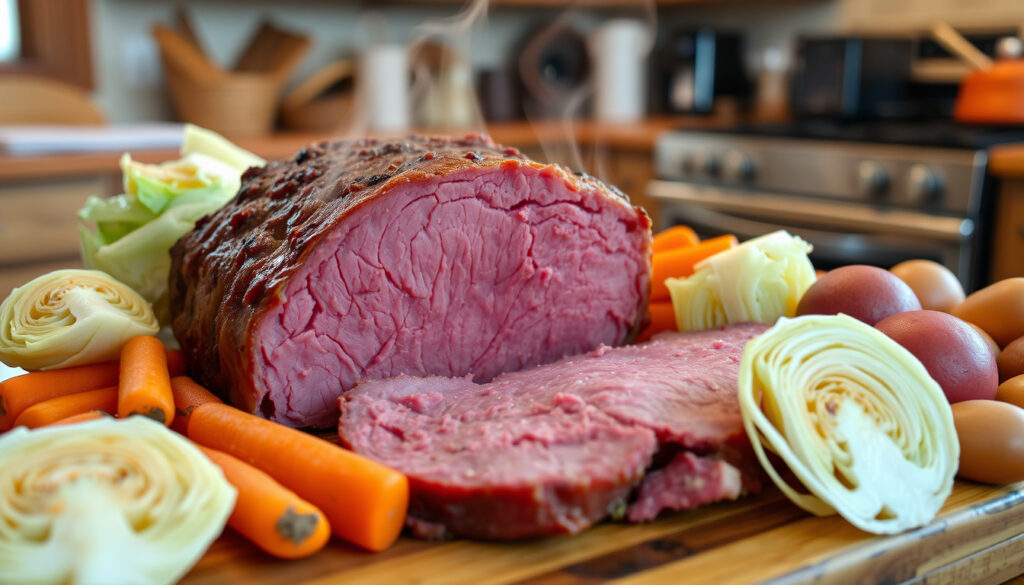
What Is Corned Beef? Definition, Nutrition, and Health Impact
Few foods carry as much cultural baggage as corned beef. It’s a centerpiece of St. Patrick’s Day feasts, a deli counter staple, and a source of persistent debate: is it a traditional Irish dish or an American invention? The truth is more layered than a Reuben sandwich.
Corned beef is a salt-cured beef brisket ·
Sodium per 3 oz serving: ~827 mg ·
Calories per 3 oz serving: ~210 ·
Historical origin: Ireland, later popularized in the United States
Quick snapshot
- Salt-cured beef brisket (Serious Eats food editorial)
- Cured with large salt grains called corns (Serious Eats food editorial)
- Popular in Irish-American cuisine (Serious Eats food editorial)
- High in protein, B vitamins
- High sodium (≈827 mg per 3 oz)
- Moderate fat content
- Processed meat – WHO Group 1 carcinogen (WHO International Agency for Research on Cancer)
- Limit intake due to sodium and saturated fat (WHO International Agency for Research on Cancer)
- Occasional consumption acceptable (WHO International Agency for Research on Cancer)
- Canned corned beef
- Corned beef hash
- Sandwiches, stews, and St. Patrick’s Day dishes
Seven key facts about corned beef, one pattern: the same curing process that preserves the meat also loads it with sodium.
| Fact | Value |
|---|---|
| Type of meat | Beef brisket |
| Curing agent | Coarse salt (corns) |
| Origin | Ireland |
| Associated holiday | St. Patrick’s Day |
| Typical serving size | 3 oz (85 g) |
| Calories per serving | 210 |
| Sodium per serving | 827 mg |
What is corned beef in Ireland?
The historical roots of corned beef in Irish cuisine
- Salt-cured beef has been produced in Ireland since at least the 17th century as a preservation method (Serious Eats food editorial).
- The term “corned beef” first appeared in print in 1621, referring to the coarse salt crystals (“corns”) used in the cure (Serious Eats).
Why this matters: the “corn” in corned beef has nothing to do with maize — it’s a relic of Old English, where any small grain of salt was called a corn.
Why corned beef is called salt beef in Ireland
- In Ireland and Commonwealth countries, the same product is commonly called “salt beef” rather than corned beef (Wikipedia free encyclopedia).
- This naming distinction reflects the ingredient’s central role in traditional Irish food preservation, where salt was the key agent.
The implication: language itself tells the story of how corned beef traveled — “salt beef” stays close to its Irish roots, while “corned beef” crossed the Atlantic with the diaspora.
The role of Irish immigrants in popularizing corned beef abroad
- Irish immigrants arriving in the United States in the 19th century found beef far cheaper than in the old country, and adopted corned beef as a staple (Gutterman’s Inc. food history site).
- Jewish deli owners in New York also adapted cured beef techniques after immigration in the late 1800s, further embedding corned beef in American food culture (Serious Eats).
The pattern: corned beef’s popularity in America is a story of immigrant thrift and adaptation, not a direct transplant from Ireland.
Is corned beef Irish or American?
The Irish origins of salt-cured beef
- Salt-cured beef production became common in Ireland during the 17th century as a way to preserve meat for export and winter storage (Gutterman’s Inc.).
- Authentic Irish cuisine traditionally used bacon or pork; beef was a luxury reserved for special occasions.
The transformation of corned beef into an American icon
- The dish as known today — corned beef and cabbage — is largely an Irish-American innovation, born when immigrants substituted beef for the more expensive Irish bacon (Gutterman’s Inc.).
- Mass production of canned corned beef in the 20th century turned it into a pantry staple worldwide.
Modern cultural associations and St. Patrick’s Day
- Corned beef and cabbage is now the definitive St. Patrick’s Day meal in the United States, even though it’s rarely eaten in Ireland itself.
- This tradition was reinforced by Irish-American communities and later by food marketing campaigns.
The catch: what most Americans think of as “Irish” corned beef is actually a hybrid — a dish born of necessity and nostalgia in the diaspora.
Corned beef is simultaneously a symbol of Irish heritage and an American adaptation. The same dish that connects millions to their roots is also a reminder that food traditions evolve when people move.
Is corned beef healthy to eat?
Nutritional profile of corned beef
- Per 3-ounce serving, corned beef provides about 210 calories, 14 g of protein, and 2.5 g of fat (from a 2-ounce serving of H-E-B brand corned beef: 14 g protein, 2.5 g fat, 30 mg cholesterol per 2 oz) (Tasting Table food editorial).
- It is also a source of B vitamins and iron, but these benefits come with a high sodium load: approximately 827 mg per 3 oz, about 36% of the daily recommended limit.
Health risks associated with processed meats
- The World Health Organization’s International Agency for Research on Cancer classifies processed meat as a Group 1 carcinogen, meaning there is strong evidence that it causes cancer in humans (WHO IARC cancer research agency).
- High intake of sodium and saturated fat from regular consumption of corned beef is linked to increased risk of hypertension, heart disease, and stroke.
How to incorporate corned beef into a balanced diet
- Occasional consumption — a few times per year rather than weekly — is considered acceptable for most healthy adults.
- Pairing with vegetables (like cabbage) and limiting portion size to 3 oz can help reduce the overall sodium and fat impact.
What this means: corned beef is not a health food, but it’s not a poison either. The dose makes the poison — and for most people, that means enjoying it as a treat, not a daily staple.
Corned beef offers protein and iron, but at the cost of high sodium and a carcinogen classification. For the average American, the occasional Reuben is fine; for someone with hypertension or a family history of colorectal cancer, the risk is higher.
Is corned beef ok for diabetics?
Impact of corned beef on blood sugar levels
- Corned beef contains essentially no carbohydrates, so it has minimal direct effect on blood glucose levels.
- However, the high sodium and saturated fat content raise concerns about cardiovascular health, which is already a major risk for people with diabetes.
Sodium and fat concerns for diabetic individuals
- The American Diabetes Association recommends limiting processed meats due to their association with increased cardiovascular risk (American Diabetes Association patient guidelines).
- A single 3-oz serving of corned beef provides nearly 40% of the daily sodium limit for someone with diabetes and hypertension.
Healthier meat alternatives for people with diabetes
- Lean poultry (skinless chicken or turkey breast), fish rich in omega-3s, and plant-based proteins like beans and lentils are better choices for daily consumption.
- If corned beef is desired, limit to 2 oz as an occasional ingredient and skip the high-sodium brine.
The pattern: for diabetics, the risk isn’t blood sugar — it’s the sodium and saturated fat that compound existing cardiovascular vulnerabilities.
What is in corned beef in the UK?
Typical ingredients in UK corned beef
- UK corned beef is often made from beef brisket or other cuts, cured with salt and spices, and is commonly sold in cans as a ready-to-eat product (Wikipedia UK food regulations section).
- UK regulations require specific fat content limits and clear labelling of ingredients, including the use of nitrates or nitrites.
Differences between UK and US corned beef
- In the UK, corned beef is almost always canned and has a finer, more uniform texture; in the US, it is typically sold uncooked in brine and requires cooking.
- US corned beef is heavily associated with St. Patrick’s Day and deli sandwiches, while UK corned beef is a pantry staple for sandwiches, hash, and salads.
Canned corned beef varieties in the UK
- Popular brands include Princes, Fray Bentos, and own-label supermarket versions, all of which are cured, cooked, and sealed in cans.
- The canning process makes it shelf-stable for years, a feature that has made it a wartime and camping staple.
The implication: the UK version of corned beef is more of a convenience food, while the US version is a specialty item tied to a holiday.
Is corned beef a junk food?
Defining junk food and where corned beef fits
- Junk food is typically defined as high in calories, low in nutritional value, and often high in fat, sugar, or salt.
- Corned beef offers protein, iron, and B vitamins, which give it more nutritional value than potato chips or candy. However, its high sodium and saturated fat content means it can’t be called a health food.
Nutritional comparison with other processed meats
- Compared to bacon or salami, corned beef is similar in protein and fat but often lower in added sugars. A 2-ounce serving of H-E-B corned beef has 2.5 g fat and 30 mg cholesterol, while the same brand’s pastrami has 3 g fat and 35 mg cholesterol (Tasting Table).
- The WHO classification of processed meat as carcinogenic applies to all of them, including corned beef (WHO IARC).
The role of corned beef in a modern diet
- Context matters: a few ounces of corned beef on a sandwich once a month is not a problem; making it a daily lunch is.
- For those looking to reduce processed meat intake, substituting with roasted turkey or grilled chicken is a simple swap.
The takeaway: corned beef sits in a gray zone — not quite junk food, but not a health food either. It’s a processed meat that should be treated as an occasional indulgence, not a dietary staple.
Five key differences between corned beef and pastrami, one pattern: pastrami is essentially corned beef that gets a smoky encore.
| Attribute | Corned Beef | Pastrami |
|---|---|---|
| Curing method | Brined (salt, sugar, spices) | Brined (same base) |
| Smoking | Not smoked — boiled or steamed | Smoked before steaming (Tasting Table) |
| Protein (per 2 oz) | 14 g (Tasting Table) | 14 g (Tasting Table) |
| Fat (per 2 oz) | 2.5 g | 3 g |
| Cholesterol (per 2 oz) | 30 mg | 35 mg |
Upsides
- Good source of protein and iron
- Contains B vitamins (B12, niacin)
- Versatile ingredient for sandwiches, stews, and hash
- Long shelf life when canned
Downsides
- Very high in sodium (827 mg per 3 oz)
- Moderate to high saturated fat
- Classified as Group 1 carcinogen by WHO
- Not suitable for daily consumption by diabetics or hypertensive individuals
Confused? Here’s what’s clear and what’s not
Confirmed facts
- Corned beef is a salt-cured beef product
More related posts
 June 2025 Social Security Schedule: Payment Dates and COLA Update
 Did Ed Gein Have a Girlfriend? Adeline Watkins Rumor Explained
 Can Dogs Have Blackberries – Safety Benefits Feeding Guide
 Does Ashwagandha Make You Horny? Libido Effects Guide
 How Much Protein Is in an Egg – Grams by Size, White and Yolk
 10 cm to Inches: Exact Conversion and Visual Guide
 How Long to Steam Broccoli? Stovetop, Microwave & More
 Lowe’s Credit Card Login: Sign In and Manage Your Account