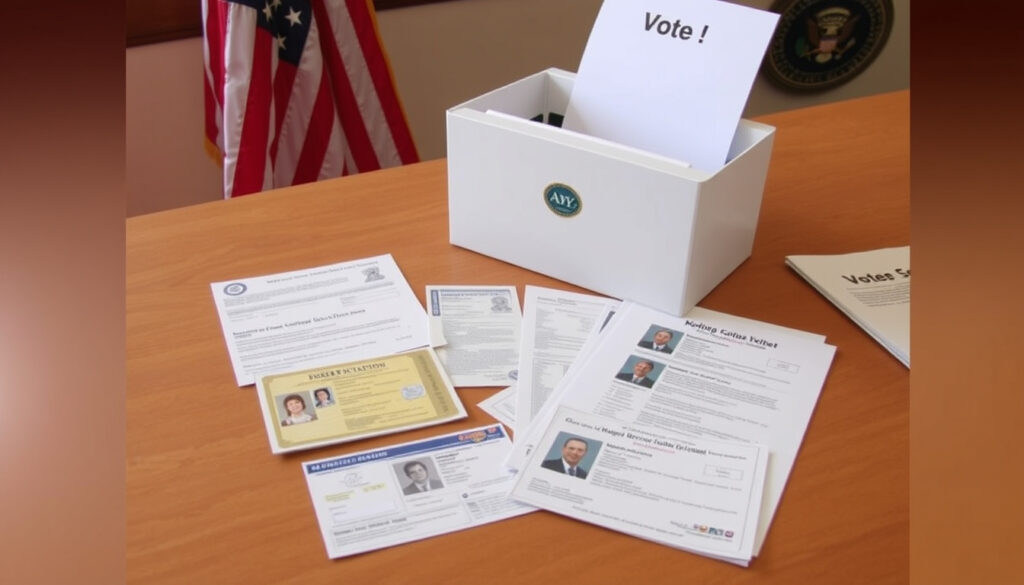
SAVE Act Voting Requirements 2025: Documents & Status
Few things raise more questions than a new law that could change how you register to vote — the SAVE Act aims to require documentary proof of U.S. citizenship for federal elections, a shift from the current attestation system. This guide breaks down exactly what the SAVE Act voting requirements are, what documents you’d need, where the legislation stands in 2025, and why it’s become such a flashpoint in election law.
Legislation number: H.R.22 (119th Congress) ·
House passage date: February 11, 2025 ·
Senate vote outcome: Stalled as of April 2025 (per Brennan Center) ·
Official name: Safeguard American Voter Eligibility Act ·
Key requirement: Documentary proof of U.S. citizenship for federal voter registration
Quick snapshot
- H.R.22 is the SAVE Act bill number (Bipartisan Policy Center (nonpartisan think tank)).
- The bill requires documentary proof of citizenship for federal voter registration (Brennan Center for Justice (nonpartisan law & policy institute)).
- The House passed the bill on February 11, 2025 (Brennan Center for Justice).
- Exact date of any final Senate floor vote, if one occurred. (Center for American Progress)
- Whether the bill will be revived in the current Congress. (Center for American Progress)
- Complete list of every permissible document (details may vary by amendment). (Center for American Progress)
- The exact number of citizens who would be affected by the requirement is unknown (Center for American Progress).
- Introduced January 2025; House passed February 11, 2025; Senate stalled April 2025.
- Future Senate action depends on floor scheduling and negotiation (Brennan Center for Justice).
Six key facts, one pattern: the SAVE Act would move from an honor-based system to a document-verification system — the biggest shift in voter registration rules in decades.
| Label | Value |
|---|---|
| Legislation number | H.R.22 (119th Congress) |
| Popular name | SAVE Act / SAVE America Act |
| House passage date | February 11, 2025 |
| Senate final outcome | Stalled as of April 2025 |
| Key provision | Documentary proof of U.S. citizenship |
| Current voter registration rule | Attestation under penalty of perjury |
What is the SAVE Act?
Official name and purpose
The SAVE Act — formally the Safeguard American Voter Eligibility Act, introduced as H.R.22 in the 119th Congress — is a federal bill that would overhaul how Americans prove their citizenship when registering to vote in federal elections (Brennan Center for Justice (nonpartisan law & policy institute)). Its core requirement: every person registering must submit documentary proof that they are a U.S. citizen, rather than merely checking a box under penalty of perjury as the current National Voter Registration Act (NVRA) allows.
- Proponents, including the White House, frame the bill as an election integrity measure requiring “a valid ID, proof of citizenship, and limiting mail-in ballots” (The White House (official executive branch)).
- The bill would amend the NVRA to mandate documentary proof of citizenship for federal voter registration (House Committee on Administration Democrats (official congressional committee document)).
- It would apply to new registrants nationwide and to already-registered voters who update their registration because of a move, name change, or party switch (House Committee on Administration Democrats).
Sponsors and legislative history
Representative Chip Roy (R-TX) introduced H.R.22 in January 2025. The bill moved quickly through the House, passing on February 11, 2025, by a vote of 218-213 (Brennan Center for Justice). Every Republican voted in favor, joined by one Democrat, while 213 Democrats and one Republican opposed it.
The implication: The SAVE Act would represent the single largest change to federal voter registration in over three decades — replacing a system used by millions of Americans every election cycle.
What Are the Voting Requirements Under the SAVE Act?
Required documents for proof of citizenship
Under the SAVE Act, the documents that would satisfy proof of citizenship are specific and limited. For most U.S. citizens, the two primary options would be a U.S. passport or a birth certificate (Center for American Progress (progressive policy think tank)). Naturalized citizens could use a naturalization certificate.
- Passport or birth certificate: The most commonly cited acceptable documents (Center for American Progress).
- Naturalization certificate: For citizens who gained citizenship through the naturalization process.
- What does NOT count: Driver’s licenses, including REAL ID-compliant licenses, and military or tribal IDs reportedly would not satisfy the bill’s requirements (Center for American Progress).
Millions of U.S. citizens do not have a passport or easy access to their birth certificate. For those updating a registration after a move, the requirement could mean an in-person trip to an election office — something current law does not demand.
How the requirement changes existing voter registration
Current federal law requires only an attestation under penalty of perjury — you sign your name confirming you are a citizen. The SAVE Act would replace that entirely with a physical document submission or verification (Bipartisan Policy Center (nonpartisan policy research organization)).
- The bill reportedly would “upend online voter registration and make mail-in registration applications impossible” (Center for American Progress).
- The requirement would apply to both online and paper registration forms (Center for American Progress).
- Already-registered voters who move, change their name, or switch parties would also need to show documentary proof again (House Committee on Administration Democrats).
The White House argues the bill protects election integrity. The Brennan Center counters that it would “prevent millions of American citizens from voting” (Brennan Center for Justice). Both sides agree the change is fundamental — they disagree on the cost.
The pattern: The change would affect not only new voters but also millions of existing voters who move or update their information.
Who Voted For and Against the SAVE Act?
House vote breakdown
The House passed the SAVE Act on February 11, 2025, on a near-party-line vote of 218-213 (Brennan Center for Justice).
- 218 votes in favor: All Republicans, plus one Democrat.
- 213 votes opposed: 213 Democrats, plus one Republican.
Key supporters and opponents
Primary supporters included House Republican leadership and the White House, which published a dedicated “SAVE America” webpage justifying the bill as necessary to prevent noncitizen voting (The White House). Opponents included House Democratic leadership and voting rights organizations like the Brennan Center and the Center for American Progress, which argued the bill would create new barriers for eligible voters without evidence of widespread noncitizen voting.
The pattern: The SAVE Act vote split almost perfectly along party lines — 99% of Republicans supported it while 99% of Democrats opposed it, mirroring the broader partisan divide over voting rules.
When Will the Senate Vote on the SAVE Act?
Senate timeline and procedural status
The Senate debated the SAVE Act in April 2025. However, despite weeks of discussion, the bill stalled and did not pass (Brennan Center for Justice). As of the latest available updates, no further vote date has been confirmed.
- Senate leadership did not bring the bill to a final vote, effectively halting its progress.
- Future Senate action depends on floor scheduling, potential amendments, and negotiation between party leaders.
What this means: Even with House passage, the SAVE Act is not law and may not pass in its current form. The Senate holds the deciding vote — and has not taken it.
What Are the SAVE Act Vote Results So Far?
House outcome
The House vote tally: 218-213 in favor on February 11, 2025 (Brennan Center for Justice). The bill passed and was sent to the Senate for consideration. The official roll-call result is available on Congress.gov.
Senate outcome (if any)
As of April 2025, the Senate has held debate but not passed the bill (Brennan Center for Justice). No final law has been enacted. The SAVE Act is stalled in the Senate, and no subsequent vote is scheduled.
The trade-off: The House delivered a clear majority for the bill, but the Senate has not followed suit. For voters, the practical consequence is zero — nothing changes until both chambers agree and the President signs.
Timeline of the SAVE Act
- January 2025: SAVE Act (H.R.22) introduced in the U.S. House of Representatives.
- February 11, 2025: House passes the SAVE Act, 218-213 (Brennan Center for Justice).
- April 2025: Senate debates the bill; it stalls and does not pass (Brennan Center for Justice).
Confirmed facts
- H.R.22 is the SAVE Act bill number.
- It requires documentary proof of citizenship for federal voter registration (Brennan Center for Justice).
- House passed the bill on February 11, 2025 (Brennan Center for Justice).
- Senate debate occurred in April 2025 (Brennan Center for Justice).
What’s unclear
- Exact date of any final Senate floor vote.
- Whether the bill will be revived in the current Congress.
- Specific list of all documents that would be accepted (details may vary in amendments).
“The SAVE Act would prevent millions of American citizens from voting.”
— Brennan Center for Justice
“The bill requires a valid ID, proof of citizenship, and limiting mail-in ballots except for specific categories such as illness, disability, military service, or travel.”
— The White House
The SAVE Act is not just another bill in Congress — it is a test of how much the voting process should change. For the millions of Americans who register online or by mail, the documentary requirement would demand something they have never had to provide. For lawmakers, the choice is between a new layer of verification and the current system that critics say leaves the door open to potential fraud. For voters, the implication is clear: understand what the SAVE Act voting requirements would mean for you, because the debate is far from over, and the outcome will affect every federal election going forward.
thearc.org, nonprofitvote.org, responsivegov.org, ballotpedia.org, facebook.com, ncsl.org
Frequently asked questions
What is the SAVE Act in simple terms?
The SAVE Act (Safeguard American Voter Eligibility Act) is a federal bill that would require Americans to show a document like a passport or birth certificate when registering to vote in federal elections, instead of merely signing a statement under penalty of perjury.
Who does the SAVE Act affect?
It would affect anyone registering to vote for the first time after the law takes effect, as well as already-registered voters who need to update their registration because of a move, name change, or party switch. It does not affect voting itself — only the registration step.
What documents are considered proof of citizenship under the SAVE Act?
A U.S. passport or birth certificate are the two primary documents mentioned by analyses from the Center for American Progress and the Brennan Center. Naturalized citizens could use a naturalization certificate. Driver’s licenses — even REAL ID-compliant ones — military IDs, and tribal IDs reportedly would not satisfy the requirement.
What happens if you don’t have a passport or birth certificate?
You would likely need to obtain one before registering — either order a certified birth certificate from your state of birth or apply for a U.S. passport. This process can take weeks or months and costs money, which critics say creates a barrier for low-income and elderly voters.
Is the SAVE Act the same as voter ID laws?
Not exactly. Voter ID laws require you to show identification at the polling place when you vote. The SAVE Act targets the registration step — it requires documentary proof of citizenship to register. The Bipartisan Policy Center notes the SAVE Act also includes a photo ID requirement at voting time.
Has the SAVE Act become law?
No. The House passed it in February 2025, but the Senate debated and stalled the bill in April 2025. It is not yet law and may not pass in its current form.
How can I find the full SAVE Act text?
The full text of H.R.22 is available on Congress.gov, the official legislative information system of the U.S. federal government. You can search for “H.R.22 — 119th Congress” to read the bill text and all amendments.
Related reading
More related posts
 New York Times Wordle of the Day – Hints for Puzzle #1761
 Can Cats Eat Grapes? Vet-Approved Risks & What to Do
 Boston to New York: Train, Bus, Flight Comparison
 What Does Ashwagandha Do? Benefits, Side Effects, and Dosage
 Kansas City Chiefs Game Today: Channel, Time & Updates
 Ear Mites in Cats – Symptoms, Treatment and Prevention
 Texas A&M vs Notre Dame: 41-40 Final Score & Recap
 One Battle After Another streaming: HBO Max, Prime & more