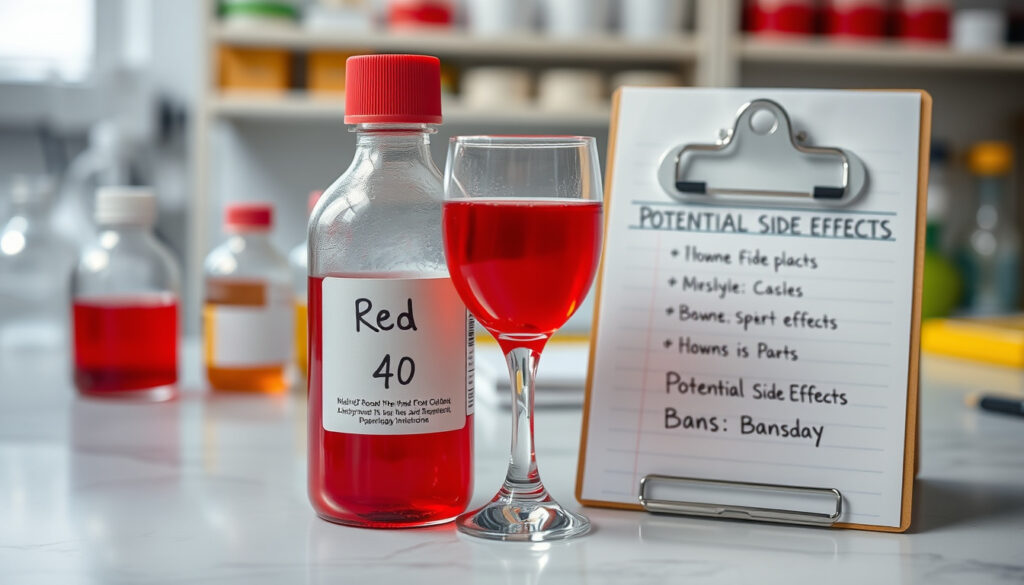
What Is Red 40? Side Effects, Bans, and Safety Explained
Few ingredients in the grocery aisle spark as much debate as Red 40. This synthetic dye colors everything from fruit snacks to soda, yet a growing body of research links it to hyperactivity in children and, more recently, DNA damage in animal studies, making understanding what Red 40 actually is—and how it affects your body—matter more than ever.
FDA approval year: 1971 · Products containing Red 40: Over 9,000 · Countries with bans: Norway, Austria, Switzerland · Linked to hyperactivity: In children with ADHD
Quick snapshot
- Red 40 is a synthetic dye derived from petroleum (U.S. FDA (food safety regulator))
- Also known as Allura Red AC and E129 in Europe (Wikipedia)
- Used in over 9,000 products including candies, beverages, and processed foods (WebMD (health information publisher))
- Whether Red 40 causes cancer in humans remains uncertain (U.S. FDA — Color Additives and Cancer)
- Long-term safety for adults at typical consumption levels has not been conclusively studied (NIH/PMC (peer-reviewed research))
- The reasons behind regulatory differences between the US and Europe are debated (Food Additives & Contaminants (academic review))
- Whether long-term consumption of Red 40 poses health risks for the general population remains debated (NIH/PMC (peer-reviewed research))
- FDA approved Red 40 in 1971 (U.S. FDA)
- 2021 California law will restrict synthetic dyes in school foods (California Legislative Information)
- More US states may follow California’s lead on synthetic dye restrictions (California Legislative Information)
- EU warning labels for azo dyes may expand to additional products (EUR-Lex (EU food additive regulation))
- Research on long-term effects and DNA damage continues (NIH/PMC)
Red 40’s chemical identity and approved limits are summarized below.
| Label | Value |
|---|---|
| Chemical name | Allura Red AC |
| Color index | CI 16035 |
| FDA approval year | 1971 |
| Acceptable daily intake | 7 mg/kg body weight |
| Common food uses | Candies, beverages, dairy products |
| EU labeling requirement | Warning for azo dyes (Southampton Six) (EUR-Lex) |
| California school restriction | AB 418 — compliance pending (California Legislative Info) |
What is Red 40?
What is red 40 made of?
- Red 40 is a synthetic azo dye manufactured from petroleum distillates (U.S. FDA (food safety regulator)).
- Its chemical structure is disodium 6-hydroxy-5-[(2-methoxy-5-methyl-4-sulfophenyl)azo]-2-naphthalenesulfonate (Wikipedia).
What is red 40 used for?
- It provides a cherry-red color to candies, soft drinks, dairy products, cereals, and baked goods (WebMD (health information publisher)).
- It also appears in cosmetics, medications, and dietary supplements (U.S. FDA).
What foods contain Red 40?
- Common items include fruit snacks, flavored yogurt, soda, hot chocolate mixes, and certain salad dressings (Academy of Nutrition and Dietetics (professional nutrition organization)).
- A 2016 survey found Red 40 in over 9,000 commercial food products (NCBI Bookshelf (medical reference)).
Red 40 is everywhere, but its petroleum base means it offers zero nutritional value—only visual appeal. For parents scanning labels, the presence of Red 40 in a product is a trade-off between color and unnecessary additives.
The implication: Red 40’s ubiquity makes it easy to encounter, but its lack of nutritional value means it’s purely cosmetic.
What does Red 40 do to your body?
How does Red 40 affect the body?
- A 2012 meta-analysis confirmed that artificial food colors, including Red 40, can increase hyperactive behavior in children with ADHD (NIH/PMC (peer-reviewed review)).
- Some individuals report allergic reactions such as hives or swelling, though these are rare (Cleveland Clinic (nonprofit medical center)).
Is Red 40 bad for you?
- The FDA considers Red 40 safe at current dietary levels (U.S. FDA — Color Additives and Cancer).
- However, a 2023 animal study found that Red 40 caused DNA damage in mouse colon cells, raising questions about long-term human exposure (NIH/PMC (peer-reviewed research)).
Red 40 and ADHD
- The European Union requires a warning on foods containing Red 40 stating it “may have an adverse effect on activity and attention in children” (EUR-Lex (EU food additive regulation)).
- Boston Children’s Hospital notes that while not all children react, those with ADHD are more sensitive to synthetic dyes (Boston Children’s Hospital (pediatric research hospital)).
“Red 40 is associated with hyperactivity in kids with ADHD.”
— Cleveland Clinic (source)
The gap between FDA and EU positions puts consumers in a bind: regulators in one region call it safe, while those across the Atlantic demand a warning label. Parents of children with ADHD face the toughest decision because the evidence, though not definitive, is strong enough to deserve caution.
The catch: The evidence linking Red 40 to behavioral effects is strong enough for EU warning labels, yet the FDA maintains its safety – a divided stance that leaves consumers to decide.
Is red dye 40 banned in the UK?
Is Red 40 banned in Europe?
- No, Red 40 is not banned across the EU. It is authorized under Regulation (EC) No 1333/2008 for specific food categories (EUR-Lex (EU food additive regulation)).
- However, Norway, Austria, and Switzerland have banned Red 40 entirely (UK Food Standards Agency (food safety regulator)).
Why is Red 40 banned in some countries?
- Those bans stem from the precautionary principle: Norway and Austria chose to prohibit synthetic dyes after the 2007 Southampton study linked them to hyperactivity (Food Additives & Contaminants (academic review)).
- The EU did not ban the dyes but instead introduced the mandatory warning label for the “Southampton Six,” which includes Red 40 (EUR-Lex).
The regulatory picture across Europe is patchy: one set of rules for the EU, a different set for individual countries. The UK, having left the EU, still permits Red 40 under its own food additive framework (UK Food Standards Agency).
| Country / Region | Status of Red 40 | Key provision |
|---|---|---|
| United States | Approved (1971) | No warning label required (U.S. FDA) |
| European Union | Approved with warning | Mandatory label: “may have an adverse effect on activity and attention in children” (EUR-Lex) |
| Norway | Banned | Prohibited since 2011 (UK FSA) |
| Austria | Banned | Prohibited since 2011 (UK FSA) |
| Switzerland | Banned | Prohibited since 2011 (UK FSA) |
| United Kingdom | Approved | Permitted; no warning label required post-Brexit (UK FSA) |
| California (USA) | Restricted in schools | AB 418 — compliance pending (California Legislative Info) |
The pattern: Red 40’s regulatory status varies by region, with bans in some European countries but allowance in the UK and US, reflecting differing tolerances for risk.
Why isn’t Red 40 banned in the US?
Why is Red 40 banned elsewhere?
- Bans in Norway and Austria reflect a stricter precautionary approach that prioritizes avoiding potential harm even when evidence is inconclusive (Food Additives & Contaminants review).
- The US system requires convincing evidence of harm before removing a listed additive, a higher bar than Europe’s precautionary principle (eCFR — U.S. color additive listing).
What is the FDA’s position?
- The FDA states that approved color additives are safe when used in accordance with regulations (U.S. FDA — Color Additives and Cancer).
- It has not imposed any warning label requirement for Red 40, unlike the EU (U.S. FDA).
“Red 40 is approved for use in food within established limits.”
— U.S. FDA (source)
American consumers enjoy brightly colored foods at low cost, but the regulatory gap means they have less information about potential behavioral effects than European shoppers. Until the FDA revisits its stance, the burden falls squarely on families to decide whether to avoid synthetic dyes.
What this means: The burden of avoiding Red 40 falls on American families, as the FDA’s stance is unlikely to change without stronger evidence of harm.
What is Red 40 called in Europe?
What is E129?
- E129 is the European food additive number for Allura Red AC (EUR-Lex (EU food additive regulation)).
- It belongs to the “Southampton Six” azo dyes that require a warning label in the EU (EUR-Lex).
What are other names for Red 40?
- FD&C Red No. 40 (US), Allura Red AC (chemical name), E129 (EU), and CI 16035 (color index) are all the same substance (Wikipedia).
“Red 40 induced DNA damage in mouse colon cells.”
— 2023 study in Environmental Toxicology (NIH/PMC)
Upsides
- Provides consistent, vibrant color at low cost (FDA)
- Widely tested within existing regulatory frameworks (EFSA (EU food safety agency))
- No confirmed link to cancer in humans (FDA)
Downsides
- Linked to hyperactivity in children with ADHD (NIH/PMC)
- Possible allergic reactions in sensitive individuals (Cleveland Clinic)
- Recent animal study suggests DNA damage risk (NIH/PMC)
- No nutritional value; purely cosmetic (Academy of Nutrition and Dietetics)
The bottom line: Knowing Red 40’s many names helps consumers identify it on labels, but the regulatory gap means the information available to shoppers varies by continent.
What’s confirmed, what’s still unclear
Confirmed facts
- Red 40 is FDA approved (FDA)
- Linked to hyperactivity in children with ADHD (NIH/PMC)
- Banned in Norway, Austria, Switzerland (UK FSA)
- Also known as E129 (Wikipedia)
What’s unclear
- Whether Red 40 causes cancer in humans (FDA)
- Whether it is safe for adults at current consumption levels (NIH/PMC)
- Why regulatory differences exist between US and Europe (Food Additives & Contaminants review)
- Whether long-term consumption of Red 40 poses health risks for the general population remains debated (NIH/PMC)
The pattern is clear: regulators agree on the science but disagree on how much uncertainty is acceptable. For American families, the absence of an EU-style warning label means the decision to limit Red 40 rests on personal risk tolerance, not government guidance.
Related reading
- Is Sunflower Oil Bad for You? Facts vs. Controversy
- What Is Collagen Good For? Benefits, Side Effects & More
Does Red 40 cause cancer?
The FDA states that approved color additives do not pose a cancer risk at current exposure levels (U.S. FDA — Color Additives and Cancer). However, a 2023 animal study reported DNA damage in mouse colon cells after Red 40 consumption (NIH/PMC (peer-reviewed research)), so the question remains open.
Is Red 40 safe for pregnant women?
No specific studies have been conducted on pregnant women. The FDA’s acceptable daily intake of 7 mg/kg body weight applies to the general population, but some doctors advise limiting synthetic dyes during pregnancy (WebMD (health information publisher)).
How much Red 40 is in common foods?
A 12-ounce can of soda may contain about 5 mg of Red 40 (Academy of Nutrition and Dietetics (professional nutrition organization)). A serving of fruit snacks can have 10–20 mg. At 7 mg/kg ADI, a 150 lb adult could safely consume about 475 mg per day—far more than typical intake.
Can Red 40 be removed from diet?
Yes, by choosing whole foods and checking labels for “FD&C Red No. 40,” “Allura Red AC,” or “E129.” The Academy of Nutrition and Dietetics offers guidance on reducing artificial dyes.
What are natural alternatives to Red 40?
Natural red colorants include beet juice, elderberry extract, and paprika extract. These are listed as “beet juice” or “vegetable juice” on ingredient labels (U.S. FDA (food safety regulator)).
Does Red 40 affect behavior in all children?
No, the effect is strongest in children with ADHD or existing sensitivity. The EU warning applies to all children, but the evidence is most consistent for the ADHD subgroup (NIH/PMC review).
Is Red 40 banned in Canada?
No, Health Canada permits Allura Red AC (E129) in food but requires it to be listed as “Allura Red AC” or “Red 40” on ingredient lists (UK Food Standards Agency (food safety regulator)). No warning label is required.
More related posts
 AAA Car Rental Discounts: Benefits, CDP Codes, and Tips 2025
 Who Won Super Bowl 2023? Chiefs Beat Philadelphia Eagles 38-35
 How Long to Steam Broccoli? Stovetop, Microwave & More
 Social Security Increase 2025 Chart: COLA & Max Benefit
 Utah Jazz vs Denver Nuggets Match Player Stats: Box Score
 SAVE Act Voting Requirements 2025: Documents & Status
 Map of African Countries – Labeled Printable Maps and 54 Nations Facts
 2026 NFL Mock Draft Simulator: Best 7-Round Tools with Trades